
Insurance · US
Contractor insurance: the complete guide for small businesses
Quick answer
Most small trade businesses need general liability with completed operations, commercial auto for work vehicles, workers' comp once they hire (rules vary by state), and often tools cover and a contractor bond required by the license board. Prices depend on sales, payroll and the type of work.
On this page
- The short version
- General liability: the policy customers ask about first
- Workers' compensation: required once you hire, with state rules
- Commercial auto: your van is not covered by general liability
- Tools and equipment cover
- Umbrella cover
- Contractor bonds are not insurance
- Packages: the business owner's policy
- How insurers work out the price
- Certificates of insurance
- What to buy first
- How to buy without overpaying
- What to do next
This article is general information about business insurance, not insurance advice. Coverage, prices and legal requirements depend on your state or country, your trade and the insurer. Check the policy wording and your local regulator before you buy.
Picture the call that every trade business owner dreads. A ladder slips and cracks a customer's stone countertop. A helper falls off a step stool and breaks a wrist. Your van rear-ends someone on the way to a job. None of these is rare, and each one can cost more than a year of profit. Insurance is what decides whether that call is a bad week or the end of the business.
The problem is that "contractor insurance" is not one policy. It is a handful of different covers, each with its own job, its own rules and its own price. This guide explains what each one does, which ones the law or your customers are likely to require, how the price is worked out, and the order in which a small trade business usually buys them. It is general information, not advice on a particular policy: the rules change from state to state, and the policy wording is what counts.
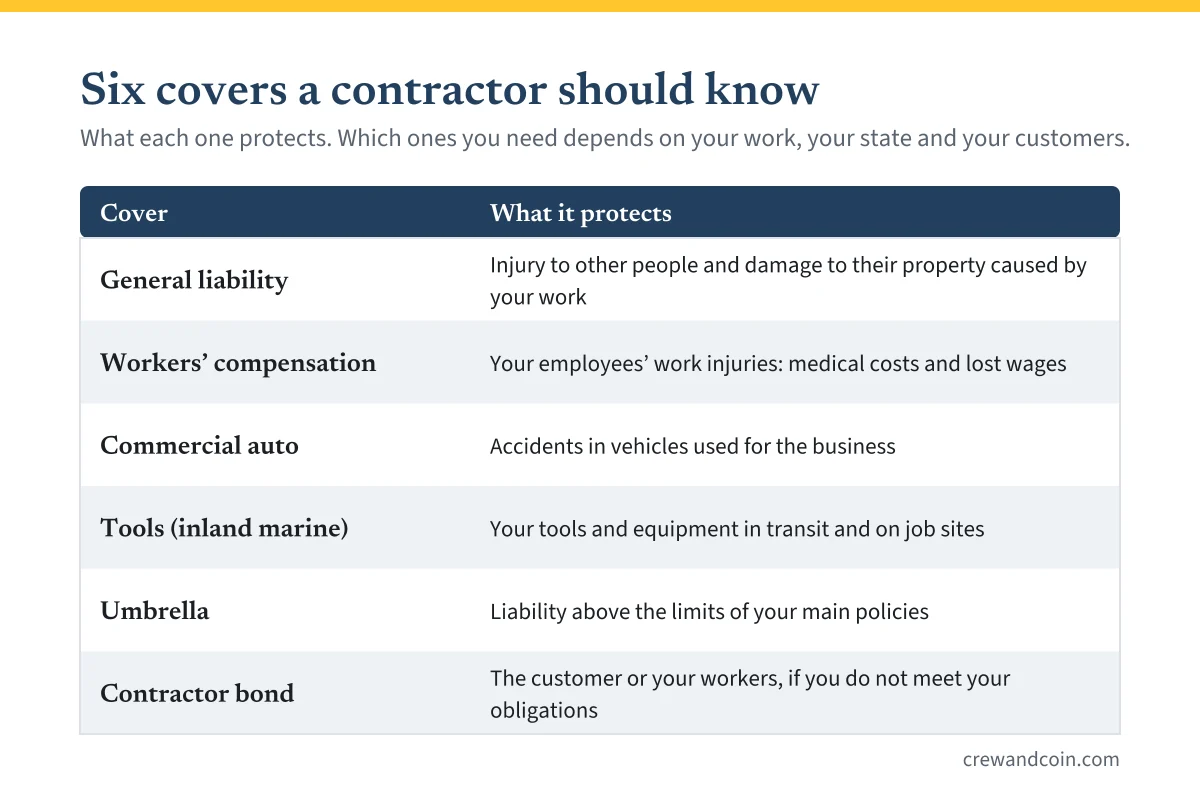
The short version
| Cover | What it protects | When it is usually required |
|---|---|---|
| General liability | Injury to other people and damage to their property caused by your work | Often by customers, property managers and some license rules |
| Workers' compensation | Your employees' work injuries | By state law once you have employees, with different thresholds in each state |
| Commercial auto | Accidents in vehicles used for the business | Whenever a vehicle is used for the business; general liability excludes vehicles |
| Tools and equipment (inland marine) | Your tools and equipment on the move and on job sites | Rarely required; protects your own property |
| Umbrella | Liability above the limits of your main policies | When contracts ask for higher limits |
| Contractor bond | The customer or your workers, if you do not meet your obligations | By some state license boards |
General liability: the policy customers ask about first
General liability is the base layer for almost every trade business. The SBA describes it as cover against financial loss from bodily injury, property damage, medical expenses, libel, slander, defending lawsuits and settlements or judgments. The NAIC, the national association of state insurance regulators, adds that it also covers certain personal injury claims such as slander and libel, and false or misleading advertising.
Just as important is what it does not cover. According to the NAIC, a standard commercial general liability policy excludes claims related to operating a vehicle, and employment claims such as wrongful termination or harassment. It also does not cover professional errors, which need separate professional liability cover. Damage to your own tools and van is not a liability claim at all; that needs property or equipment cover.
For a trade business, one part of general liability matters more than most people realize: completed operations. The NAIC's glossary describes completed operations liability as cover for the liability of contractors, plumbers, electricians, repair shops and similar firms for work they have finished. A leak from a fitting you installed three weeks ago is a completed operations claim, not an accident on the day.
The guide to general liability insurance for contractors goes through limits, exclusions and how to read a quote. If you work alone and take jobs from general contractors, see the version for independent contractors.
Workers' compensation: required once you hire, with state rules
Workers' compensation pays for medical costs, rehabilitation and lost wages when an employee is hurt at work. The NAIC notes that nearly all U.S. states require employers to buy it, and that business owners, independent contractors and certain other workers are often exempt, with rules that vary by state.
How much the rules vary is easiest to see in three large states:
| State | Who must carry workers' comp |
|---|---|
| California | Every employer with one or more employees |
| Florida | Construction employers with one or more employees; most other employers with four or more |
| Texas | Most private employers can choose; those without it must tell the state and report certain injuries |
The details, including exemptions and penalties, are in the guide to workers' comp for contractors. If you are about to take on your first employee, the guide to hiring your first employee puts workers' comp in order with the rest of the paperwork. If you have no employees, the guide to workers' comp for independent contractors explains exemptions and why clients still ask.
Commercial auto: your van is not covered by general liability
Because general liability excludes vehicles, the van or truck needs its own cover. The NAIC warns that business-related liability may be excluded from a personal auto policy, and that commercial vehicle insurance typically carries higher liability limits and special provisions for rented and other non-owned vehicles. If a vehicle is used to carry tools, materials or a crew, tell your insurer exactly how it is used before anything happens. The guide to commercial auto insurance for contractors covers employees' cars, rentals and tools in the van.
Tools and equipment cover
Tools are the business, and they spend their life in a van, a trailer or someone else's driveway. The NAIC's glossary describes inland marine insurance as coverage for property that may be in transit, held by someone else or at a fixed location. In practice it is the cover many insurers use for contractors' tools and equipment. Ask whether the policy covers theft from a locked vehicle and from job sites, and whether it pays replacement cost or the depreciated value.
Umbrella cover
An umbrella policy sits on top of your liability policies and pays once their limits are used up. The NAIC says limits typically range from $1 million to $5 million. Small trade businesses usually add one when a commercial customer's contract asks for limits above what the main policy provides.
Contractor bonds are not insurance
Some license boards require a bond. California, for example, requires a $25,000 contractor bond for an active license, filed for the benefit of consumers harmed by defective construction and of employees owed unpaid wages. A bond protects the customer or the worker, not you. Ask your state license board whether a bond applies to your trade. The guide to contractor bonds explains license, bid, performance and fidelity bonds.
Packages: the business owner's policy
A business owner's policy, or BOP, bundles cover into one product. The SBA describes it as a package that combines typical coverage options into one bundle, and the NAIC says it typically includes property, business interruption and liability insurance. The NAIC also lists what it does not include: commercial auto, workers' compensation, health or disability insurance, and claims for professional errors. A BOP can be good value for a trade business with a shop or storage unit, but it does not replace the separate policies above.
How insurers work out the price
You will not find an official price list for contractor insurance, because insurers set their own rates. What regulators do explain is what the price is based on.
General liability. The NAIC says liability premiums are typically linked to a business's sales and payroll estimates. If the real figures turn out higher, you may owe more at the end of the policy; if they are lower, you may get money back. The type of work also matters: a roofer and a house cleaner do not present the same risk.
Workers' compensation. The California Department of Insurance explains that the payroll for each job classification is estimated and multiplied, per $100 of payroll, by the rate for that classification. Oregon's small business ombudsman gives the same formula: projected payroll times the classification rate, divided by 100. An experience modification then adjusts the result: below 100 percent reflects better-than-average claims history, above 100 percent worse.
Here is how that works with example figures. The rate below is invented to show the method; your real rate depends on your state, your classification and your insurer.
| Line | How it is worked out | Amount |
|---|---|---|
| Payroll for the year | Two employees | $72,000 |
| Classification rate (example) | Per $100 of payroll | $9.50 |
| Base premium | $72,000 ÷ 100 × $9.50 | $6,840 |
| Experience modification (example) | 90%, a better-than-average history | × 0.90 |
| Estimated premium | $6,156 |
For context, the Bureau of Labor Statistics reports that private employers spent an average of $0.43 per hour worked on workers' compensation in June 2026. That average covers every kind of business, including offices; trade work is usually classed as higher risk, so expect your own figure to be higher.
Certificates of insurance
Sooner or later a property manager, a general contractor or a homeowner will ask for a certificate of insurance before you start. The FTC tells homeowners to ask contractors for proof of insurance, so expect the question.
Two points about certificates save trouble. First, a certificate only describes your policy. Texas's insurance department, for example, says a certificate may not use terms that alter, amend or extend the coverage in the policy. Second, if a customer asks to be named as an additional insured, that has to be done in the policy itself, through an endorsement. Ask your agent for the endorsement, not just the certificate.
What to buy first
For a small trade business, the order usually looks like this:
- Whatever your license requires. Check your state license board for bonds, insurance minimums and proof of workers' comp. California, for example, requires LLC contractors to carry liability insurance with a cumulative limit of at least $1 million when five or fewer people are on the license record.
- General liability, with completed operations, before the first paid job in someone else's home.
- Commercial auto, or confirmation in writing that your auto policy covers the way you use the vehicle.
- Tools and equipment cover, once the tools would be hard to replace out of savings.
- Workers' compensation, before the first employee's first day, or earlier if your state requires it.
- Umbrella, when contracts ask for higher limits.
Every one of these is a cost the business carries every month, so it belongs in your overhead and in your prices. The complete pricing guide shows how to spread it across your billable hours.
How to buy without overpaying
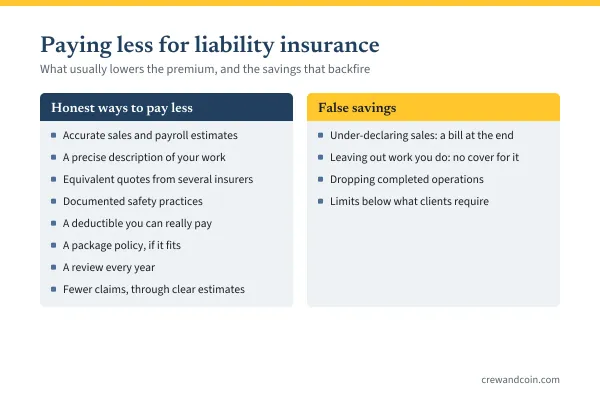
The SBA's advice is short: assess your risks, find a reputable licensed agent and shop around, because prices and benefits can vary significantly. The guide on how to pay less for contractor liability insurance goes through what you can change. The NAIC adds three useful points: compare the cost of equivalent coverage from several insurers, make sure your agent understands your business, and keep documented safety practices, which can help lower liability premiums.
A mistake a lot of new owners make is describing the business too vaguely to save a few dollars. If the policy says "handyman" and the claim comes from a roof repair, the insurer will look closely at whether roofing was ever covered. Describe every kind of work you do.
What to do next
List the work you do, the vehicles you use and whether you have or plan to have employees. Check your state license board for any required bond or insurance, then ask at least two licensed agents for quotes on equivalent cover. The trade-specific guide on handyman insurance shows how this works for one of the most varied trades, and the guide to cleaning business insurance does the same for cleaning companies, and the guide to painting contractor insurance for painters.
Frequently asked questions
What insurance does a small contractor need?
Usually general liability with completed operations, commercial auto for work vehicles, workers' compensation once there are employees, and any bond or insurance the state license board requires. Tools cover and an umbrella policy are common additions.
Is workers' comp required for contractors?
It depends on the state and on whether you have employees. California requires it with one or more employees, Florida with one or more in construction, and Texas lets most private employers choose.
How is contractor insurance priced?
Regulators explain that liability premiums are usually linked to sales and payroll estimates, and workers' comp premiums to payroll per $100 multiplied by a classification rate and adjusted by an experience modification.
More on insurance

Insurance · US
General liability insurance for independent contractors
Insurance · US
How to pay less for contractor liability insurance
Sources
- NAIC: Small business insurance
- NAIC: Glossary of insurance terms
- SBA: Get business insurance
- California Department of Industrial Relations: Workers' compensation FAQs
- Florida Division of Workers' Compensation: Coverage requirements
- Texas Department of Insurance: Workers' compensation for employers
- California Department of Insurance: Workers' compensation
- Oregon DCBS Small Business Ombudsman: How much does it cost?
- U.S. Bureau of Labor Statistics: Employer Costs for Employee Compensation, Table 1
- CSLB: Bond requirements
- CSLB: Licenses for limited liability companies
- Texas Department of Insurance: Certificates of insurance FAQ
- FTC: How to avoid a home improvement scam