
Insurance · US
Contractor bonds explained: license, surety and bid bonds
Quick answer
A contractor bond is a three-party guarantee: a surety guarantees your obligations to a license board or project owner, and you must repay the surety for any claim. License bonds are set by states; federal construction contracts over $150,000 need performance and payment bonds.
This article is general information about business insurance, not insurance advice. Coverage, prices and legal requirements depend on your state or country, your trade and the insurer. Check the policy wording and your local regulator before you buy.
Sooner or later a trade business hears the word "bonded." A license board asks for a bond before it issues a license. A property manager asks whether you are bonded. A public contract asks for a bid bond with the proposal and performance and payment bonds once you win. They all sound alike, but they protect different people and work very differently from insurance.
This guide explains the main types of bond a contractor meets, who each one protects, what the federal rules say for public work, how the SBA can help a small business get bonded, and how to apply. It is part of the complete guide to contractor insurance. Bond rules are set by states, local governments and project owners, so confirm the requirement that applies to you.
How a bond works: three parties
Texas's insurance regulator describes a surety bond as an agreement between three parties: the surety, an insurance company that guarantees the faithful performance of the principal (you, the contractor), to the obligee, the owner or entity expecting the obligation to be completed.
The key difference from insurance is who pays in the end. An insurance policy pays covered losses for you. A bond guarantees your obligations to someone else, and the surety expects to be repaid. Texas notes that the indemnity agreement, signed with the bond application or separately, requires that the surety be completely indemnified against any liability, loss, cost, attorney's fees and expenses it sustains by having been surety on the bond. In plain words: if the surety pays a claim because of you, you owe it back.
That is also why getting bonded feels like applying for credit. The SBA notes that surety companies look at your credit, capacity and character.
The main types of bond
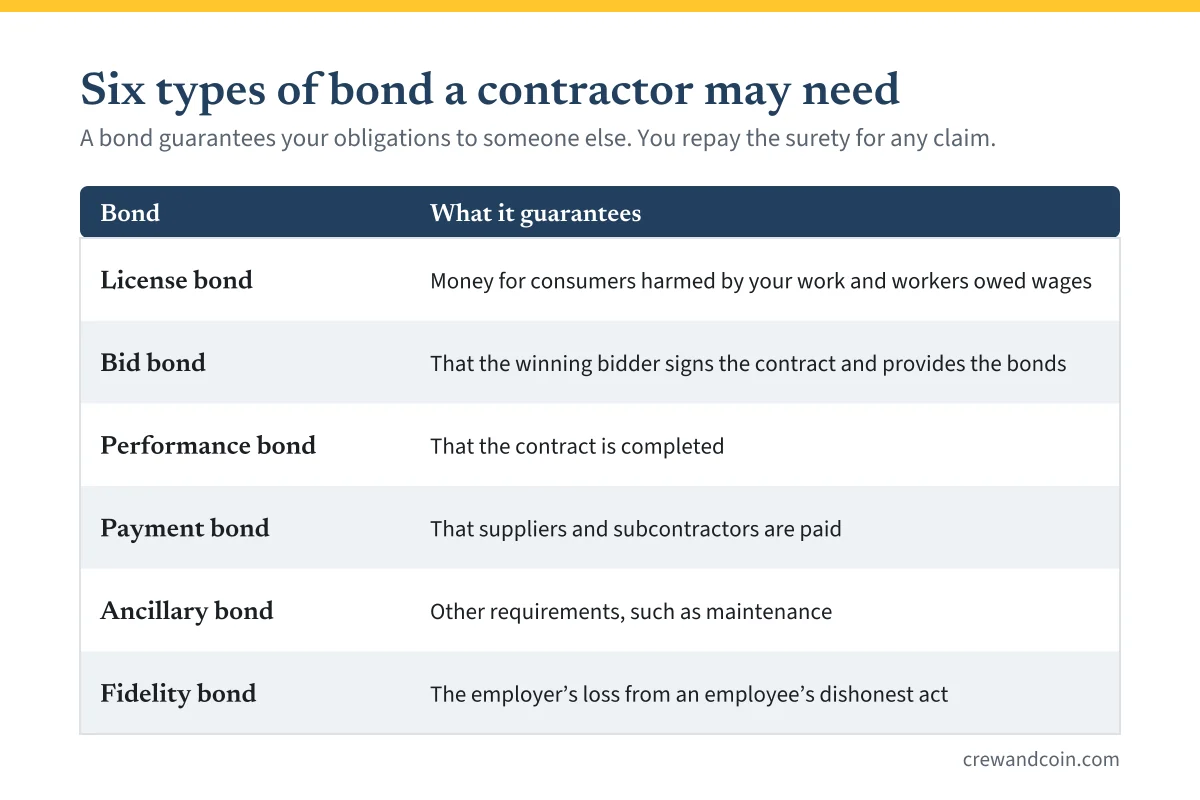
| Bond | What it guarantees | Who usually asks for it |
|---|---|---|
| License bond | Money for consumers harmed by your work and workers owed wages (California's rule) | State and local license boards |
| Bid bond | That if you win, you will sign the contract and provide the required bonds | Owners of bid projects, especially public ones |
| Performance bond | That you complete the contract | Project owners |
| Payment bond | That you pay your suppliers and subcontractors | Project owners |
| Ancillary bond | Requirements beyond performance and payment, such as maintenance | Project owners |
| Fidelity bond | The employer's loss from an employee's dishonest act | Cleaning and service clients |
License bonds
Many license boards require a bond before they issue or renew a license. California is a clear example: the Contractors State License Board requires a $25,000 contractor bond, in place since January 1, 2023, filed for the benefit of consumers harmed by defective construction and of employees owed unpaid wages. Contractors licensed as LLCs in California also need an additional $100,000 bond for the benefit of their employees and workers.
Your state, county or city may require a license bond for some trades and not others. Ask your license board directly.
Bid, performance and payment bonds
These are the contract bonds. The SBA describes them this way:
- Bid: ensures full payment and performance bonding from the contract bidder.
- Payment: ensures full payment to the suppliers and subcontractors.
- Performance: ensures full completion of a contract.
- Ancillary: ensures completion of requirements outside performance or payment, such as maintenance.
On federal construction work the rules are written down. Under the Federal Acquisition Regulation, the Miller Act requires performance and payment bonds for any construction contract exceeding $150,000. For contracts above $35,000 and up to $150,000, the contracting officer has to choose at least two payment protections from a list that includes payment bonds and alternatives such as letters of credit. Where a bid guarantee is required, it must be at least 20 percent of the bid price, up to $3 million.
State and local public projects follow their own rules, and private owners can ask for bonds in the contract. Read the bid documents for the exact requirement before you price the job.
Fidelity bonds
Fidelity bonds are a different family. The NAIC's glossary describes fidelity cover as a bond or policy covering an employer's loss resulting from an employee's dishonest act. In cleaning and other service trades, being "bonded" usually means this. The guide to cleaning business insurance explains how it fits with liability insurance.
Help from the SBA
Small businesses without a long track record can struggle to get bonded. The SBA's Surety Bond Guarantee program guarantees bid, performance, payment and ancillary bonds issued by participating surety companies, which can help a smaller contractor get bonded.
According to the SBA:
- It covers contracts of up to $9 million for non-federal work and up to $14 million for federal contracts.
- There is no fee for bid bonds. For performance and payment bond guarantees, the fee is 0.6 percent of the contract price.
- The business has to qualify as small under SBA size standards and meet the surety's credit, capacity and character requirements.
For example, on a $400,000 contract the SBA guarantee fee would be $400,000 × 0.006 = $2,400, on top of whatever the surety charges for the bond itself. Put both into your bid.
How to get bonded
- Find out exactly what is required: the bond type, the amount and the obligee, from the license board or the bid documents.
- Talk to a surety agent or your insurance agent, and ask whether they write contractor bonds.
- Prepare your records. Expect questions about your credit, your finances, your experience and the jobs you have completed.
- Read the indemnity agreement before you sign. It is what makes you responsible for repaying the surety.
- Price the bond into the job. A bond cost that is not in the bid comes out of your profit, as the complete pricing guide explains.
Common mistakes
- Treating a bond as insurance for yourself. It protects the customer, the workers or the project owner.
- Waiting until the bid deadline to apply. Bonding takes time.
- Forgetting the bond cost in the bid price.
- Confusing a license bond with a fidelity bond when a client asks whether you are "bonded."
What to do next
Ask your license board whether your trade needs a license bond, and read the bond section of any bid you plan to submit. If you need contract bonds and have little bonding history, look at the SBA's Surety Bond Guarantee program and talk to a surety agent who works with it.
Frequently asked questions
Is a contractor bond the same as insurance?
No. A bond guarantees your obligations to someone else, and the indemnity agreement makes you repay the surety for any claim it pays. Insurance pays covered losses for you.
When are performance and payment bonds required?
On federal construction contracts, the Miller Act requires them for contracts over $150,000. State, local and private projects set their own rules in their bid documents and contracts.
Can the SBA help me get bonded?
Yes. The SBA's Surety Bond Guarantee program guarantees bonds from participating sureties for contracts up to $9 million, or $14 million for federal work, with no fee for bid bonds and 0.6% of the contract price for performance and payment bonds.
More on insurance

Insurance · US
General liability insurance for contractors: cover and costs

Insurance · US