
Insurance · US
General liability insurance for independent contractors
Quick answer
An independent contractor's general liability policy covers injury and property damage caused by their work, plus legal defense. Check for completed operations, occurrence form, limits that meet client agreements and an additional insured endorsement. Price depends on sales estimates and type of work.
This article is general information about business insurance, not insurance advice. Coverage, prices and legal requirements depend on your state or country, your trade and the insurer. Check the policy wording and your local regulator before you buy.
Say you work on your own: a painter, a handyman or a tile setter who picks up jobs from homeowners, property managers and a couple of general contractors. One of those contractors sends a new agreement before the next job. Page three says you must carry general liability insurance, name them as an additional insured and send a certificate before you start. No policy, no work.
That is the moment many independent contractors look into liability insurance for the first time. This guide explains what it does for a one-person trade business, what clients usually ask for, how a sole proprietor's personal assets come into it, and what to check before you buy. It is part of the complete guide to contractor insurance, and it is general information, not advice on a particular policy.
Who counts as an independent contractor
The IRS's general rule is that you are an independent contractor if the person paying you has the right to control or direct only the result of the work, not what will be done and how it will be done. You set your own methods and hours, bring your own tools and usually work for more than one client.
That status has two consequences worth knowing:
- Taxes. The IRS says the earnings of an independent contractor are subject to self-employment tax.
- Insurance. Nobody else's policy is built to cover your work. The general contractor's insurance protects the general contractor; your liability for your own work is yours to insure.
What general liability does for you
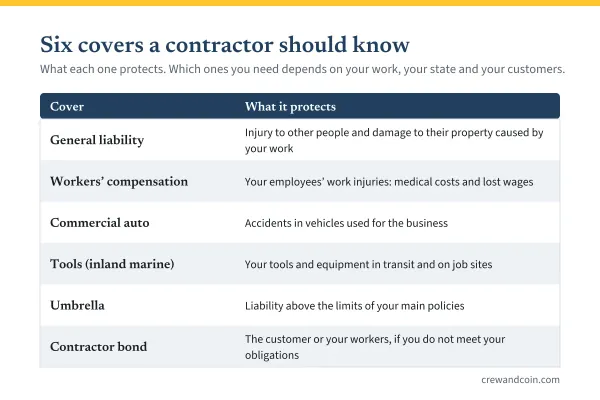
The SBA describes general liability as cover against financial loss from bodily injury, property damage, medical expenses, libel, slander, defending lawsuits, and settlements or judgments. For a one-person trade business, that means the damaged floor, the cracked window, the visitor who trips over your hose, and the lawyer if someone sues.
Two features matter most for independent trade work:
- Products and completed operations. The NAIC's glossary describes completed operations liability as cover for contractors, plumbers, electricians and similar firms for work that is finished. Most trade claims arrive after you have left.
- The policy form. With an occurrence policy, the policy in force when the damage happened responds. With a claims-made form, both the event and the claim must fall within the policy period, so stopping or switching policies can leave old work uncovered.
The guide to general liability insurance for contractors covers exclusions and limits in more detail.
Your personal assets
How you set up the business changes what is at stake. The SBA explains that with a sole proprietorship you can be held personally liable for the debts and obligations of the business, because the business and you are not legally separate. An LLC, according to the SBA, protects you from personal liability in most instances.
An LLC does not replace insurance. It changes whose money is at risk, not whether a customer can claim, and some states set insurance minimums for LLC contractors. California, for example, requires LLC contractors to carry liability insurance with a cumulative limit of at least $1 million when five or fewer people are on the license record. The guide to starting a home service business covers choosing a structure.
What clients usually ask an independent contractor for
General contractors, property managers and commercial clients often set their requirements in a subcontract or vendor agreement. Read it before the first job, and expect some of these:
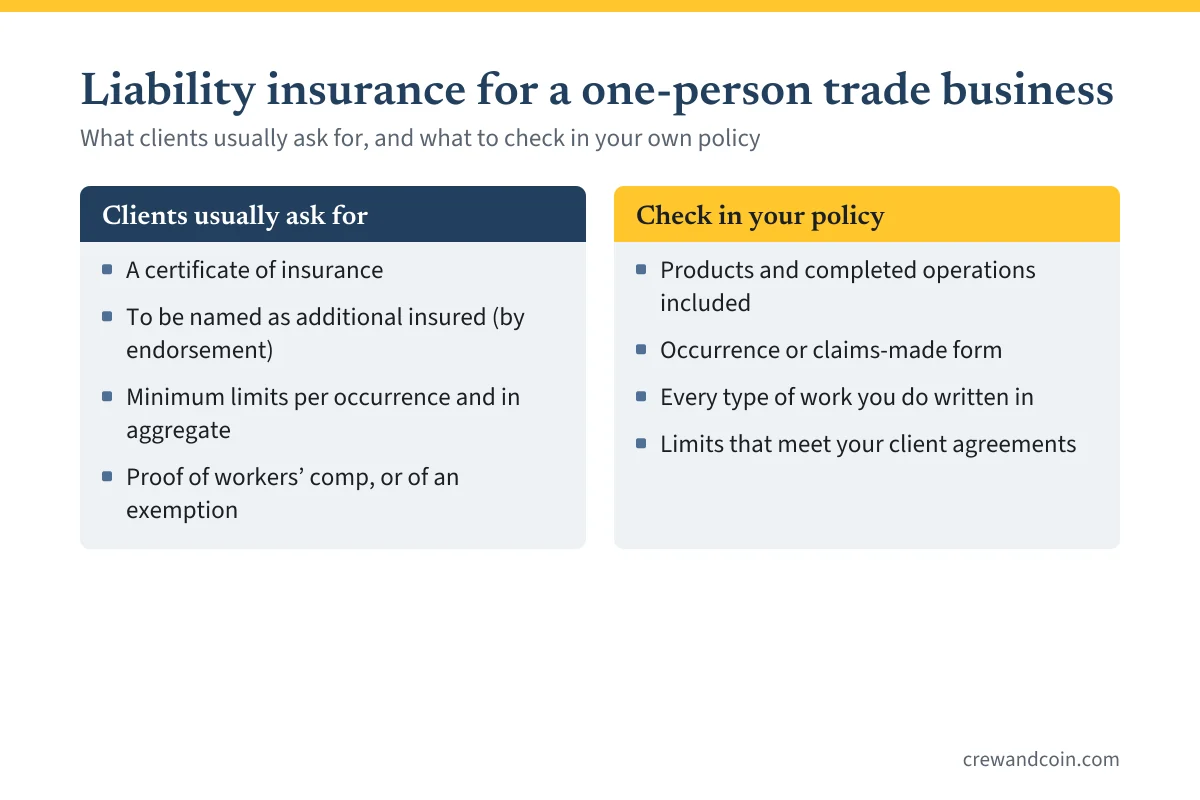
- A certificate of insurance. It summarizes your policy. Texas's insurance department, for example, says a certificate may not alter, amend or extend the coverage in the policy.
- Additional insured status. The client wants to be added to your policy. According to the same Texas guidance, that requires an endorsement in the policy; the certificate alone cannot do it.
- Minimum limits, per occurrence and in aggregate.
- Proof of workers' comp, or of an exemption. As a one-person business you may be exempt in your state, but clients often want to see it in writing. The guide to workers' comp for independent contractors explains why.
Send the agreement to your insurance agent before you sign it. They can tell you whether your policy, or an endorsement, meets each requirement.
How the price is set for a one-person business
There is no official price list. The NAIC explains that liability premiums are typically linked to a business's sales and payroll estimates, and that the figure may be adjusted at the end of the policy if the real numbers differ. For a sole operator with no payroll, your estimated sales and the type of work are what move the price.
Three habits keep it fair:
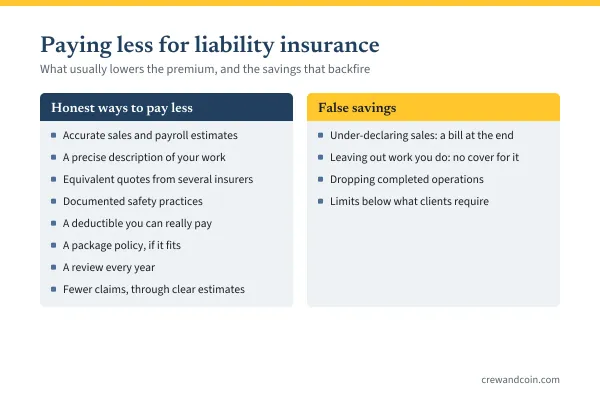
- Estimate sales honestly. A low estimate brings a lower quote now and a bill at the audit.
- Describe every kind of work. If you paint and sometimes pressure wash, say both.
- Compare equivalent cover. The NAIC suggests comparing the cost of equivalent coverage from several insurers. Give each agent the same limits, form and description.
Then add the yearly cost to your overhead and spread it across your billable hours. The guide to setting a handyman hourly rate shows how a one-person business turns costs like this into a rate.
Checklist before you buy
- Products and completed operations included.
- Occurrence or claims-made form, and what happens to past work if you switch.
- Limits that meet the agreements you sign most often.
- Additional insured endorsement available, blanket or per client.
- Every type of work you do written into the policy.
- A deductible you can pay from the business account.
What to do next
Gather the agreements you have signed or expect to sign, list the work you do and your yearly sales, and ask two licensed agents for quotes on the same terms. Ask each one specifically about completed operations and additional insured endorsements.
Frequently asked questions
Do independent contractors need general liability insurance?
Often, yes. Many clients require it in their agreements, some states require it for certain licensees, and without it you pay any claim for your work yourself.
Does the general contractor's insurance cover me as a subcontractor?
Do not count on it. The general contractor's policy protects the general contractor, which is why most ask subcontractors for their own certificate and to be named as an additional insured.
Does an LLC replace liability insurance?
No. The SBA says an LLC protects your personal assets in most instances, but customers can still claim against the business, and some states set insurance minimums for LLC contractors.
More on insurance
Insurance · US
How to pay less for contractor liability insurance
Insurance · US
Contractor insurance: the complete guide for small businesses

Insurance · US