Insurance · US
Workers' comp for independent contractors: who needs it
Quick answer
Business owners and true independent contractors are often exempt from workers' comp, but it depends on the state. California requires it for some license classes even without employees, Florida counts construction LLC members, and Texas lets most employers choose. Clients may require it anyway.
This article is general information about business insurance, not insurance advice. Coverage, prices and legal requirements depend on your state or country, your trade and the insurer. Check the policy wording and your local regulator before you buy.
Picture a one-person roofing business in California, or a two-owner painting LLC in Florida. Neither has employees in the usual sense. Both may still need workers' compensation, one because of its license classification and the other because the owners themselves count. And a general contractor down the road may refuse to hire either of them without proof of cover or of an exemption.
Workers' comp for independent contractors is confusing because the answer depends on three things: your state, how your business is set up, and whether the people working with you are really independent. This guide walks through each, with official examples from three states. It is part of the complete guide to contractor insurance, and it is general information: confirm the rules with your state's workers' compensation agency.
The starting point: owners are often exempt
The NAIC, the national association of state insurance regulators, says nearly all states require employers to carry workers' comp, and that business owners, independent contractors and certain other workers are often exempt, with rules that vary by state. So a true one-person business, with no employees, is often outside the requirement. "Often" is doing a lot of work in that sentence.
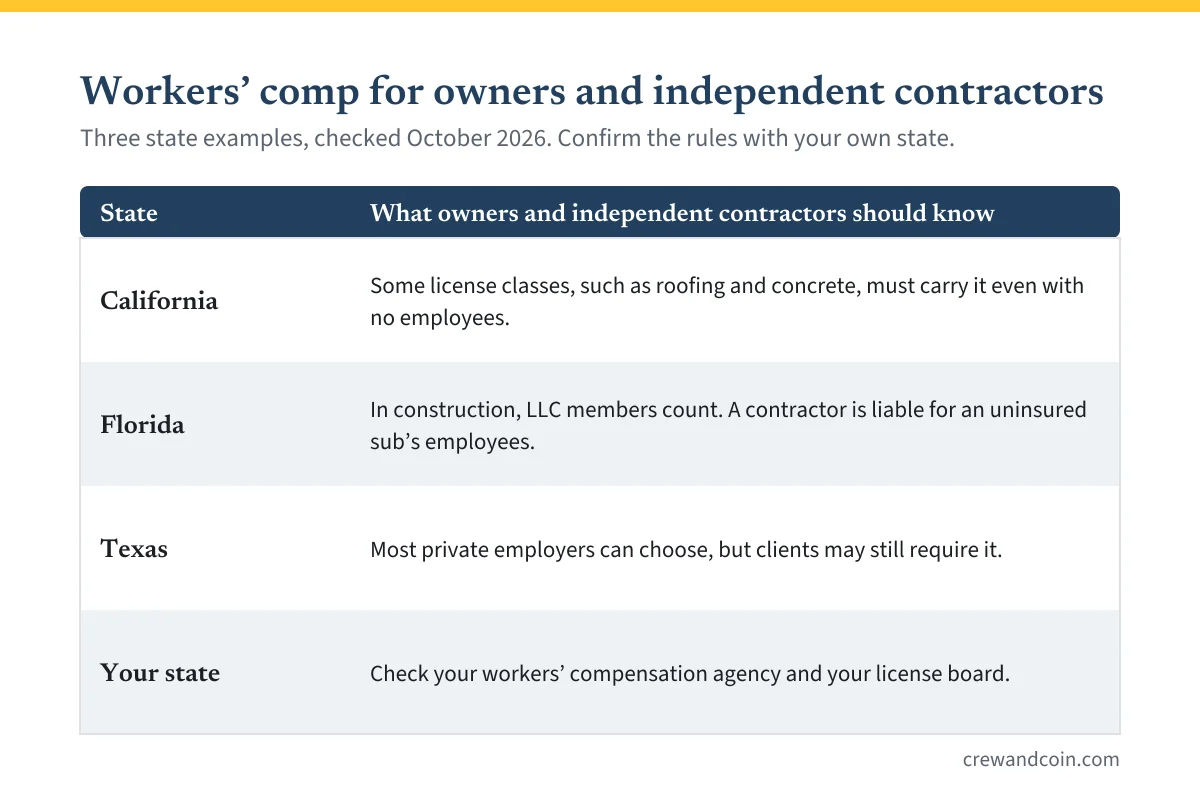
Three state examples
| State | What independent contractors and owners need to know |
|---|---|
| California | Required with one employee or more. Some contractor license classes, including roofing, must carry it with no employees at all |
| Florida | In construction, corporate officers and LLC members count toward the one-employee threshold; owners can apply for an exemption. A contractor is responsible for an uninsured subcontractor's employees |
| Texas | Most private employers can choose whether to carry it |
California
California's Department of Industrial Relations says every employer with one or more employees must have workers' comp. A sole proprietor may buy cover for themselves, but it must be stated in the policy or added by endorsement, and the department notes that health, life or disability income insurance may be a better option for a sole proprietor.
For licensed contractors, the Contractors State License Board adds its own rules. Contractors with no employees can file a signed exemption certifying that they have no employees. But active contractors in five classifications must carry workers' comp, or a certificate of self-insurance, whether or not they have employees: C-8 Concrete, C-20 Warm-Air Heating, Ventilating and Air-Conditioning, C-22 Asbestos Abatement, C-39 Roofing and C-61/D-49 Tree Service. If an exempt contractor hires someone, the exemption is no longer valid, and proof of coverage must reach the board within 90 days of the hire.
Florida
Florida's Division of Workers' Compensation requires construction employers with one or more employees to carry cover, and it counts corporate officers and LLC members toward that number. That is why a construction LLC run by its owners can fall under the rule. Owners who meet the requirements can apply for an exemption.
Florida law also explains why general contractors ask so many questions. Under section 440.10 of the Florida Statutes, when a contractor sublets part of its work, the contractor is liable for, and must secure, compensation for the subcontractors' employees on that work, except for the employees of a subcontractor who has secured it. A general contractor who hires an uninsured subcontractor takes on that risk, so expect to be asked for a certificate or an exemption.
Texas
The Texas Department of Insurance says private employers can choose to carry workers' compensation, and that it is not required in most cases. Those that do not carry it must report that to the state. Contracts can still require it, so a Texas contractor may need it to win work even when the law does not demand it.
Are the people working with you really independent?
The exemption only works if the business really has no employees. Calling a helper an independent contractor does not make them one. California, for example, says its Labor Code defines who counts as an employee for workers' comp. The IRS uses its own test for tax purposes: the payer of an independent contractor has the right to control only the result of the work, not what will be done and how.
If your "subcontractor" works only for you, on your schedule, with your tools and to your methods, the relationship looks like employment, and the workers' comp rules for employers apply. The guide to hiring your first employee explains the IRS categories in more detail.
Why buy it when you are exempt
There are three common reasons a one-person business carries workers' comp anyway:
- Clients require it. General contractors and commercial clients often set it as a condition, for the reasons Florida's law makes clear.
- Your license requires it. As California's roofing and concrete classifications show, some licenses do not care whether you have employees.
- You are about to hire. Having the policy in place before the first helper starts avoids a gap, and in California the board expects proof within 90 days of the hire.
If none of those applies, ask your agent to compare the cost of covering yourself with the alternatives California's department mentions, such as disability income insurance. They protect you in different ways, and the right choice depends on your situation.
How the price is set
When you buy workers' comp, the price follows the same method as for any employer. The California Department of Insurance explains that payroll for each job classification is multiplied, per $100 of payroll, by that classification's rate, and then adjusted by an experience modification. If you are covering only yourself, ask your insurer how your own pay is counted. The guide to workers' comp for contractors works through an example.
Checklist
- Find your state's workers' compensation agency and read the rules for owners and sole proprietors.
- Check your license board for classifications that need cover without employees.
- File any exemption your state or board requires, and keep a copy for clients.
- Look at every person who works with you honestly: employee or independent?
- Read your client agreements for workers' comp requirements.
- Arrange cover before the first employee starts.
What to do next
Check your state agency and license board, file the exemption if you qualify, and keep a copy ready for clients. If you also need liability cover for client agreements, the guide to general liability insurance for independent contractors covers what to buy and what clients ask for.
Frequently asked questions
Do independent contractors need workers' comp?
Often not, if they have no employees, but it depends on the state and the license. California requires some contractor classifications, such as roofing, to carry it even without employees.
Why does a general contractor ask for my workers' comp?
In some states the general contractor can be responsible for an uninsured subcontractor's employees. Florida's law, for example, makes the contractor liable for them unless the subcontractor has secured coverage.
Does a workers' comp exemption cover me if I get hurt?
No. An exemption only shows you are not required to carry workers' comp. It pays nothing after an injury, so plan separately for your own income and medical costs.
More on insurance
Insurance · US
Contractor insurance: the complete guide for small businesses

Insurance · US
Cleaning business insurance: what cover you need
Sources
- NAIC: Small business insurance
- California Department of Industrial Relations: Workers' compensation FAQs
- CSLB: Workers' compensation requirements
- Florida Division of Workers' Compensation: Coverage requirements
- Florida Statutes: section 440.10, liability for compensation
- Texas Department of Insurance: Workers' compensation for employers
- IRS: Independent contractor defined
- California Department of Insurance: Workers' compensation