Starting
How to hire your first employee in a trade business
Quick answer
Check that your prices cover the hire, confirm the worker is an employee and not a contractor, get an EIN and state tax accounts, put workers' compensation in place, collect Form W-4, complete Form I-9 within three business days, report the hire to your state within 20 days and set up payroll.
Picture this: it is the middle of spring, the phone rings four times before lunch, and you turn down two jobs because there are only so many hours in a week. A helper would fix that. Then you start reading about payroll, forms and insurance, and decide to work Saturdays instead.
Hiring the first employee is a paperwork job more than a difficult one. Most of it happens once, in a set order, and the rest becomes a routine. This guide covers the federal steps every U.S. employer goes through, what a first hire really costs per hour and how to check that your prices can carry it. State rules sit on top of the federal ones, so each section says where to check yours.
If you are still setting up the business itself, start with the guide to starting a home service business and come back when the calendar is full.
First question: are you ready to hire?
Being busy is not the test. The test is whether the extra work a second person lets you take pays for that person, with profit left over. Three signs that it might:
- You turn away work every week, or book it so far out that customers go elsewhere.
- Your prices already cover your full costs. If they do not, a hire multiplies the loss.
- You have enough cash to pay wages for a few weeks before the extra invoices are paid.
If the second point is in doubt, fix prices first. A business that loses a little on every job will lose more with two people doing them.
Employee or independent contractor?
Many owners try to skip all of this by calling the helper a contractor. It is not a choice you get to make by label. The IRS looks at the whole relationship, in three groups of evidence:
| Category | The question the IRS asks |
|---|---|
| Behavioral | Does the company control, or have the right to control, what the worker does and how they do the job? |
| Financial | Does the payer control the business side of the job: how the worker is paid, whether expenses are reimbursed, who provides tools and supplies? |
| Type of relationship | Are there written contracts or employee-type benefits? Will the relationship continue, and is the work a key aspect of the business? |
Run a typical helper through those questions. You tell them where to be and when. You show them how you want the job done. They use your tools and your van. They work for you every week, doing the core work of the business. That is what an employee looks like.
If you truly cannot tell, either side can ask the IRS to decide by filing Form SS-8, though the IRS warns it may take at least six months to get an answer. A faster route is an hour with an accountant before the first day of work. Your state may apply its own test for unemployment insurance and workers' compensation, so ask those agencies too.
The setup, step by step
The SBA and the IRS describe the same sequence. Do it in this order.
1. Get an EIN and your state tax accounts
You need an Employer Identification Number to run payroll. The IRS issues it for free online. Then find out whether you need state or local tax IDs: the SBA tells new employers to contact their state tax office about employment taxes. Ask that office which accounts an employer in your state has to open before the first payday.
2. Get workers' compensation in place
According to the SBA, the federal government requires every business with employees to have workers' compensation, unemployment and disability insurance, and some states require additional insurance. How you buy workers' compensation, and who is exempt, is set by each state. Call your state's workers' compensation agency or an insurance agent before the employee's first day, not after. Get a real quote for your trade and your payroll rather than guessing the cost.
3. Have the employee fill in Form W-4
The IRS tells employers to ask every new employee for a signed Form W-4 when they start work. It tells you how much federal income tax to withhold from their pay. You also need each employee's name and Social Security number for the Form W-2 you issue after the end of the year.
4. Complete Form I-9
All U.S. employers must complete Form I-9 for every person they hire, to verify identity and permission to work. The timing is strict:
- The employee completes Section 1 at the time of hire.
- You review their documents and complete Section 2 within three business days of the date of hire. USCIS gives the example of an employee who starts on Monday: Section 2 must be done by Thursday.
You do not send the form anywhere. You keep it: for three years after the date of hire or one year after employment ends, whichever is later.
5. Report the new hire to your state
Employers have to report each new employee to the state's new hire directory within 20 days of the hire date, according to the SBA. Your state's new hire reporting website explains how and confirms the deadline that applies to you.
6. Put up the required posters
The SBA lists displaying employee rights posters as a workplace requirement. The Department of Labor provides free electronic copies of the federal ones, and its elaws Poster Advisor tells you which apply to your business. Nobody needs to sell you a poster set. Your state labor department has its own list.
7. Set up payroll
Pick a pay period, decide who runs payroll and decide whether to do it in-house or through a payroll service. For a first hire, I'd pay for a service. It calculates withholding, makes the deposits and files the forms, and the monthly fee is small next to the cost of a missed deposit.
The taxes you pay and the taxes you withhold
Two different things happen on every paycheck. Some money is taken out of the employee's pay and sent in on their behalf. Some is paid by you on top of the wage.
| Tax | Employee pays (withheld) | Employer pays |
|---|---|---|
| Federal income tax | Per their Form W-4 | Nothing |
| Social Security | 6.2% | 6.2% |
| Medicare | 1.45% | 1.45% |
| Federal unemployment (FUTA) | Nothing | 6.0% on the first $7,000 of wages per employee per year |
| State unemployment | Depends on the state | Rate set by your state |
On FUTA, the IRS allows a credit of up to 5.4 percent for state unemployment taxes paid, which brings the rate down to 0.6 percent. On $7,000 that is $42 per employee per year. Only the employer pays FUTA; it is not deducted from wages.
The filing routine looks like this:
- Form 941 every quarter, reporting federal income tax withheld and Social Security and Medicare taxes.
- Form 940 once a year for FUTA, due January 31.
- Form W-2 for each employee, filed with the Social Security Administration by January 31.
- Deposits by electronic funds transfer, on a monthly or semiweekly schedule that the IRS rules assign to you.
Pay rules: minimum wage and overtime
The Fair Labor Standards Act sets the federal floor. The federal minimum wage is $7.25 an hour, and overtime pay of at least one and a half times the regular rate is required after 40 hours of work in a workweek. Where an employee is covered by both state and federal minimum wage laws, they are entitled to the higher one. The Department of Labor publishes a state-by-state table, and many states set theirs well above the federal rate.
Overtime is the rule that catches trade businesses in the busy season. A helper who works 50 hours in a week is owed ten hours at time and a half. Build that into the price of rush work, or schedule to avoid it.
What a first employee really costs
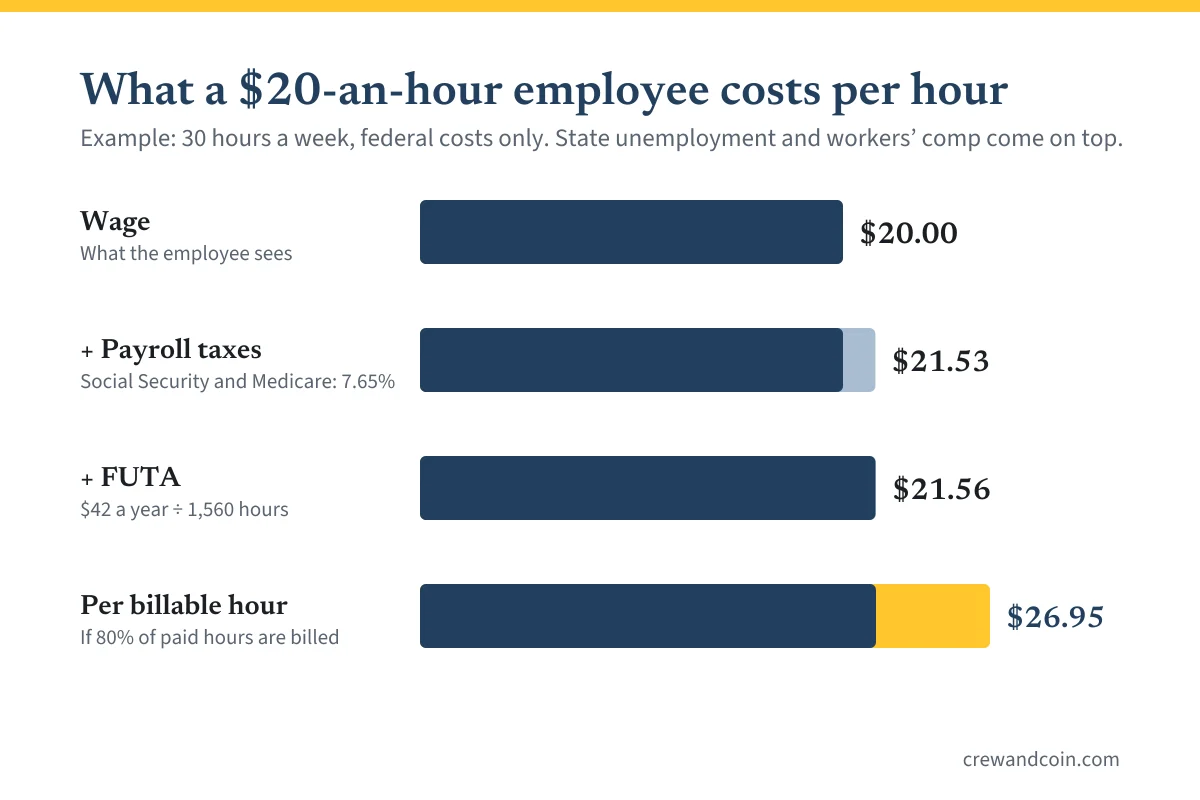
The wage is where the cost starts, not where it ends. Here is a part-time helper at $20 an hour for 30 hours a week, using only the federal figures above.
| Line | How it is worked out | Per year |
|---|---|---|
| Wages | $20 × 30 h × 52 weeks (1,560 h) | $31,200.00 |
| Employer Social Security and Medicare | 7.65% of wages | $2,386.80 |
| FUTA, with the full credit | 0.6% of $7,000 | $42.00 |
| State unemployment | Your state's rate | Your number |
| Workers' compensation | Your quote | Your number |
| Total before the two state lines | $33,628.80 |
That is $21.56 per paid hour before state unemployment, workers' compensation and any paid time off.
Now the part most owners miss. Not every paid hour ends up on an invoice. If 80 percent of the helper's hours are billable, 1,248 hours a year have to carry the whole cost: $33,628.80 ÷ 1,248 = $26.95 per billable hour, still before the two state lines.
For a sanity check, the Bureau of Labor Statistics reports that wages were 70.0 percent of what private employers spent on compensation in June 2026. By that national average, a $20 wage costs about $28.57 an hour in total. Your own number will differ, but if your estimate is far below that, something is missing.
Take that hourly cost to the complete pricing guide, add overhead and margin, and compare the result with what you charge today. If the price does not cover it, raise the price before you hire. The job price calculator does the arithmetic.
Records to keep
The SBA notes that the IRS requires employment tax records to be kept for at least four years. Keep a folder per employee with the W-4, pay records, tax deposits and filed returns. Store I-9 forms separately, since they follow their own retention rule.
Your first-hire checklist
- Prices checked against the real cost per billable hour.
- Employee or contractor decided with the three IRS categories.
- EIN in hand; state tax and unemployment accounts opened.
- Workers' compensation in place before day one.
- Form W-4 signed on the first day.
- Form I-9: Section 1 at hire, Section 2 within three business days.
- New hire reported to the state within 20 days.
- Federal and state posters displayed.
- Payroll service set up; deposit schedule known.
- A folder for records, kept at least four years.
What to do next
Work out the cost per billable hour for the wage you plan to offer, then call your state's labor and workers' compensation agencies to fill in the two blank lines. If you run a cleaning company, the guide to starting a cleaning business covers the safety training that applies once you have staff using chemical products.
Frequently asked questions
Can I pay my first helper as an independent contractor?
Only if the relationship really is one. The IRS looks at behavioral control, financial control and the type of relationship. A helper who works your schedule, with your tools, doing the core work of your business usually looks like an employee.
How long do I have to complete Form I-9?
The employee completes Section 1 at the time of hire, and the employer must complete Section 2 within three business days of the date of hire, according to USCIS.
How much does an employee cost beyond the wage?
At the federal level the employer pays 6.2% for Social Security and 1.45% for Medicare on wages, plus FUTA of 6.0% on the first $7,000 per employee, reduced to 0.6% with the full state credit. State unemployment tax and workers' compensation come on top.
More on starting
Sources
- SBA: Hire and manage employees
- IRS: Independent contractor (self-employed) or employee?
- IRS: Get an employer identification number
- SBA: Get business insurance
- IRS: Hiring employees
- USCIS: Handbook for Employers M-274, who must complete Form I-9
- USCIS: Form I-9, Employment Eligibility Verification
- U.S. Department of Labor: Workplace posters
- IRS: Topic no. 751, Social Security and Medicare withholding rates
- IRS: Topic no. 759, Form 940 and FUTA tax
- IRS: Federal unemployment tax
- IRS: Depositing and reporting employment taxes
- U.S. Department of Labor: Wages and the Fair Labor Standards Act
- U.S. Department of Labor: State minimum wage laws
- U.S. Bureau of Labor Statistics: Employer Costs for Employee Compensation