Insurance · US
Workers' comp for contractors: when you need it and what it costs
Quick answer
Most states require workers' comp once you have employees, but thresholds differ: California from one employee, Florida from one in construction, while Texas lets most employers choose. The premium is payroll divided by 100, times your classification rate, adjusted by your experience modification.
This article is general information about business insurance, not insurance advice. Coverage, prices and legal requirements depend on your state or country, your trade and the insurer. Check the policy wording and your local regulator before you buy.
Picture your first helper on their third day. They step off a ladder wrong, land on the edge of a bucket and break an ankle. Six weeks off work, a hospital bill and physical therapy. Whether that turns into a claim your insurer handles or a debt that lands on you depends on one policy: workers' compensation.
This guide covers when a contractor has to carry workers' comp, how the rules differ between states, how the premium is worked out, and how to keep the cost under control. It is part of the complete guide to contractor insurance. Workers' comp is set by state law, so treat everything here as a starting point and confirm the rules with your own state's agency.
What workers' comp does
Workers' compensation pays for an employee's medical costs, rehabilitation and lost wages after a work-related injury. The NAIC, the national association of state insurance regulators, says nearly all U.S. states require employers to buy a workers' compensation policy to cover employees.
It is separate from general liability. General liability pays for harm to people who are not your employees; workers' comp pays for harm to the people who are. If you have staff, you need to think about both.
When you have to carry it
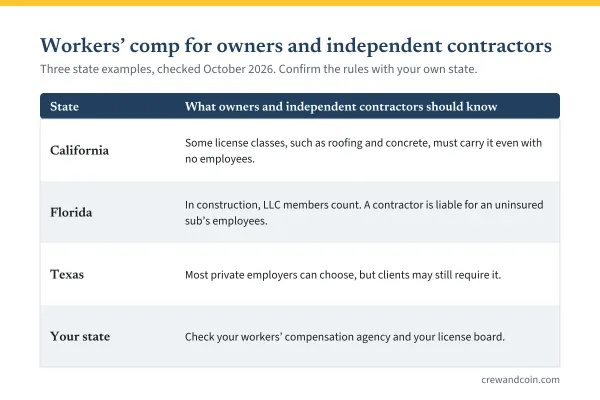
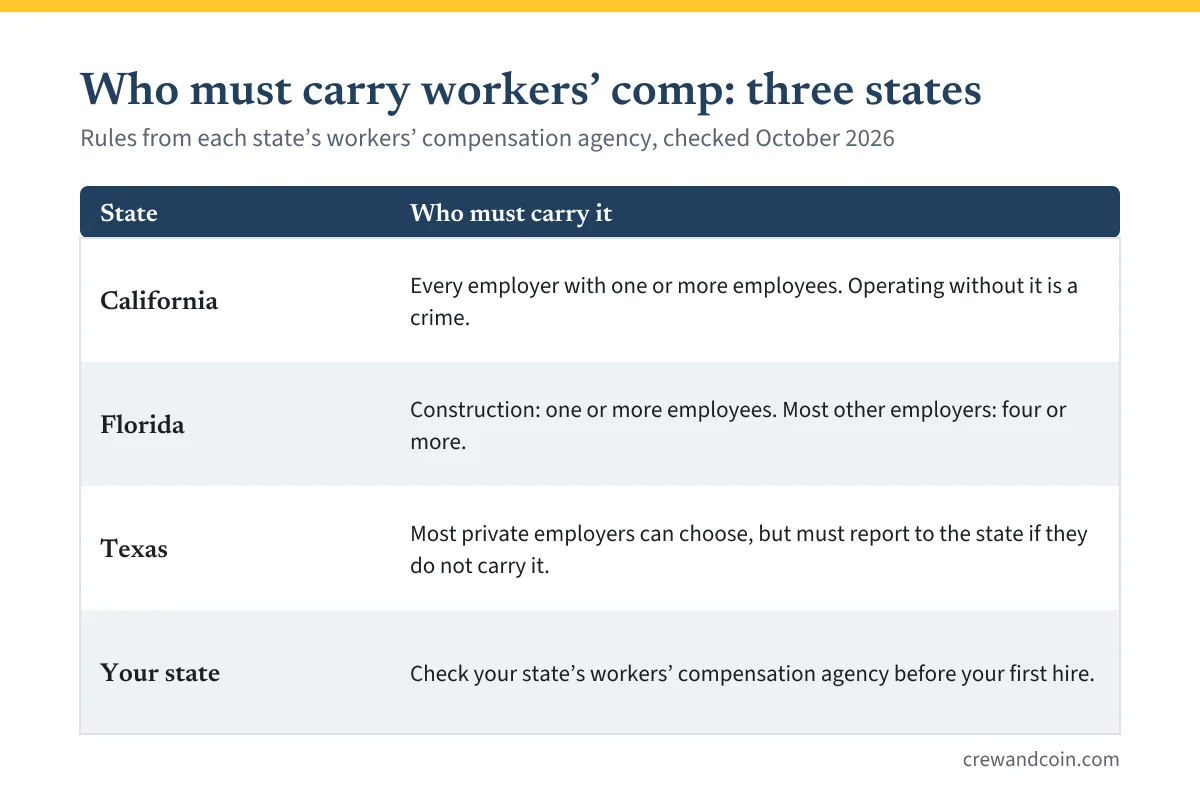
The NAIC notes that business owners, independent contractors and certain other workers are often exempt, but the rules vary by state. Three large states show how wide the range is:
| State | Who must carry workers' comp | Worth knowing |
|---|---|---|
| California | Every employer with one or more employees | Operating without it is a crime, and the state can issue a stop order and penalties of up to $100,000 |
| Florida | Construction employers with one or more employees; non-construction employers with four or more | Corporate officers and LLC members count toward the threshold; owners can apply for an exemption |
| Texas | Most private employers can choose | Employers without it must report that to the state and report work injuries with more than one day of lost time |
A few details from those agencies are worth knowing:
- California. The Department of Industrial Relations says that if a business employs one or more employees, it must satisfy the requirement. An uninsured employer also has to pay the injured worker's bills and can face a civil lawsuit from the employee. A sole proprietor may buy cover for themselves, but it has to be stated in the policy or added by endorsement.
- Florida. The state's Division of Workers' Compensation counts corporate officers and LLC members toward the threshold, which is why a two-owner painting LLC can need cover even without other staff, unless the owners qualify for and apply for an exemption.
- Texas. The Texas Department of Insurance says that, except when gross negligence results in a death, coverage limits an employer's liability if an employee sues. An employer without it does not get that limit.
Your state's rules may be closer to any of these, or different again. The U.S. Department of Labor keeps a list of every state's workers' compensation agency, which is the place to confirm the rules that apply to you.
Employees, contractors and helpers
Calling a helper an independent contractor does not take them out of workers' comp if the relationship is really employment. California, for example, says its Labor Code defines who counts as an employee, and that definition decides who has to be covered. The IRS uses its own test for tax purposes, based on behavioral control, financial control and the type of relationship, as explained in the guide to hiring your first employee.
If you use subcontractors, ask each one for a certificate of their own workers' comp cover, or proof of exemption, before they start, and ask your agent how your policy and your state treat uninsured subcontractors.
How the premium is worked out
There is no national price, but regulators publish the method. The California Department of Insurance explains that the payroll for each job classification is estimated and multiplied, per $100 of payroll, by the rate for that classification. Oregon's small business ombudsman gives the same formula: twelve-month projected payroll times the classification rate, divided by 100.
Then the experience modification adjusts it. In California's words, an experience modification below 100 percent reflects better-than-average experience, and one above 100 percent reflects worse-than-average experience. A business with few claims pays less than the base rate; a business with several pays more.
Here is the method with example figures. The rate is invented to show the arithmetic; yours depends on your state, your classification and your insurer.
| Line | How it is worked out | Amount |
|---|---|---|
| Payroll for the year | Two employees, $36,000 each | $72,000 |
| Classification rate (example) | Per $100 of payroll | $9.50 |
| Base premium | $72,000 ÷ 100 × $9.50 | $6,840 |
| Experience modification (example) | 85% | × 0.85 |
| Estimated premium | $5,814 | |
| Per hour worked | $5,814 ÷ 4,160 hours (2 × 2,080) | about $1.40 |
That last line is the one to carry into your prices. Workers' comp is part of what an hour of labor costs you, alongside wages and payroll taxes, and the complete pricing guide shows where it fits.
For context, the Bureau of Labor Statistics reports that private employers spent an average of $0.43 per hour worked on workers' compensation in June 2026. That average includes offices and shops; trade work is usually in higher-risk classifications.
The audit at the end of the year
Because the premium is based on estimated payroll, the final figure comes later. The California Department of Insurance explains that the final premium cannot be calculated until the policy term is over. If payroll was higher than estimated, you owe more; if it was lower, the insurer owes you a return premium. It also notes that insurers can generally audit payroll during the policy and for three years after it ends, and that refusing an audit can lead to cancellation and a much larger bill.
So keep payroll records by job type, and update your insurer when you hire, so the estimate stays close to reality.
Five ways to keep the cost down
- Check your classification. The class code drives the rate. California explains how to dispute a classification: contact your agent or underwriter, then the insurer in writing, then the Department of Insurance if needed.
- Keep payroll split by type of work. Oregon's ombudsman explains that each type of work has its own classification and rate, and riskier work has higher rates. Make sure office payroll is not reported as field work.
- Work safely, and document it. Fewer claims mean a better experience modification over time.
- Report injuries promptly, as your policy and your state's rules require.
- Get quotes from more than one insurer, through a licensed agent who knows trade businesses.
What to do next
Look up your state's rules through its workers' compensation agency, and ask a licensed agent for a quote using your real payroll estimate and the right classification. Then add the per-hour cost to your labor rate. Workers' comp only covers your employees; for injury and damage to other people, read the guide to general liability insurance for contractors.
Frequently asked questions
Do I need workers' comp if I have no employees?
Often not, but it depends on the state. The NAIC notes that business owners and independent contractors are often exempt. Some states, like Florida, count corporate officers and LLC members, so check your state's rules.
How is workers' comp calculated for contractors?
Payroll for each job classification is divided by 100 and multiplied by that classification's rate. An experience modification then raises or lowers the result based on your claims history.
Why did I get a bill after my workers' comp policy ended?
Because the premium is based on estimated payroll. California's Department of Insurance explains that the final premium is calculated after the term ends; if payroll was higher than estimated, you owe more.
More on insurance

Insurance · US
General liability insurance for contractors: cover and costs

Insurance · US
Handyman insurance: what you need and what it costs
Insurance · US
How to pay less for contractor liability insurance
Sources
- NAIC: Small business insurance
- California Department of Industrial Relations: Workers' compensation FAQs
- Florida Division of Workers' Compensation: Coverage requirements
- Texas Department of Insurance: Workers' compensation for employers
- U.S. Department of Labor: State workers' compensation officials
- California Department of Insurance: Workers' compensation
- Oregon DCBS Small Business Ombudsman: How much does it cost?
- U.S. Bureau of Labor Statistics: Employer Costs for Employee Compensation, Table 1