Insurance · US
General liability insurance for contractors: cover and costs
Quick answer
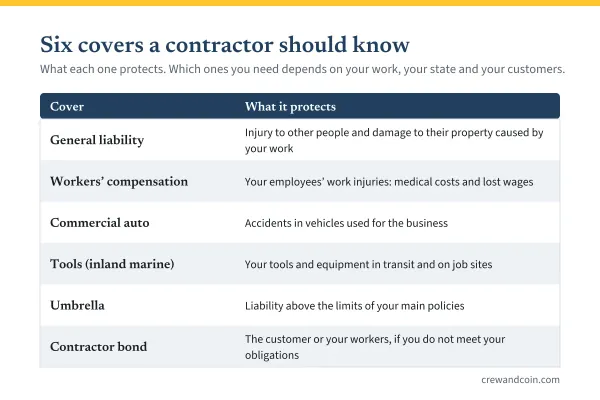
General liability covers injury to other people and damage to their property caused by your work, plus legal defense. Make sure it includes products and completed operations. It does not cover vehicles, your employees' injuries, employment claims, professional errors or your own tools.
This article is general information about business insurance, not insurance advice. Coverage, prices and legal requirements depend on your state or country, your trade and the insurer. Check the policy wording and your local regulator before you buy.
Say you are fitting a new vanity in a customer's bathroom. Two weeks later, a fitting you tightened gives way and water runs through the ceiling of the kitchen below. The customer's insurer pays for the repair, then sends the bill to you. That is exactly the kind of claim general liability insurance exists for, and it is why property managers, general contractors and careful homeowners ask for it before you start.
This guide explains what a contractor's general liability policy covers, what it leaves out, how limits and the price work, and what to check before you sign. It is one part of the complete guide to contractor insurance, and it is general information: the policy wording is what decides a claim, and rules vary by state.
What general liability covers
The SBA describes general liability as cover against financial loss from bodily injury, property damage, medical expenses, libel, slander, defending lawsuits, and settlements or judgments. The NAIC, the national association of state insurance regulators, describes commercial general liability the same way and adds false or misleading advertising.
For a trade business, that usually means:
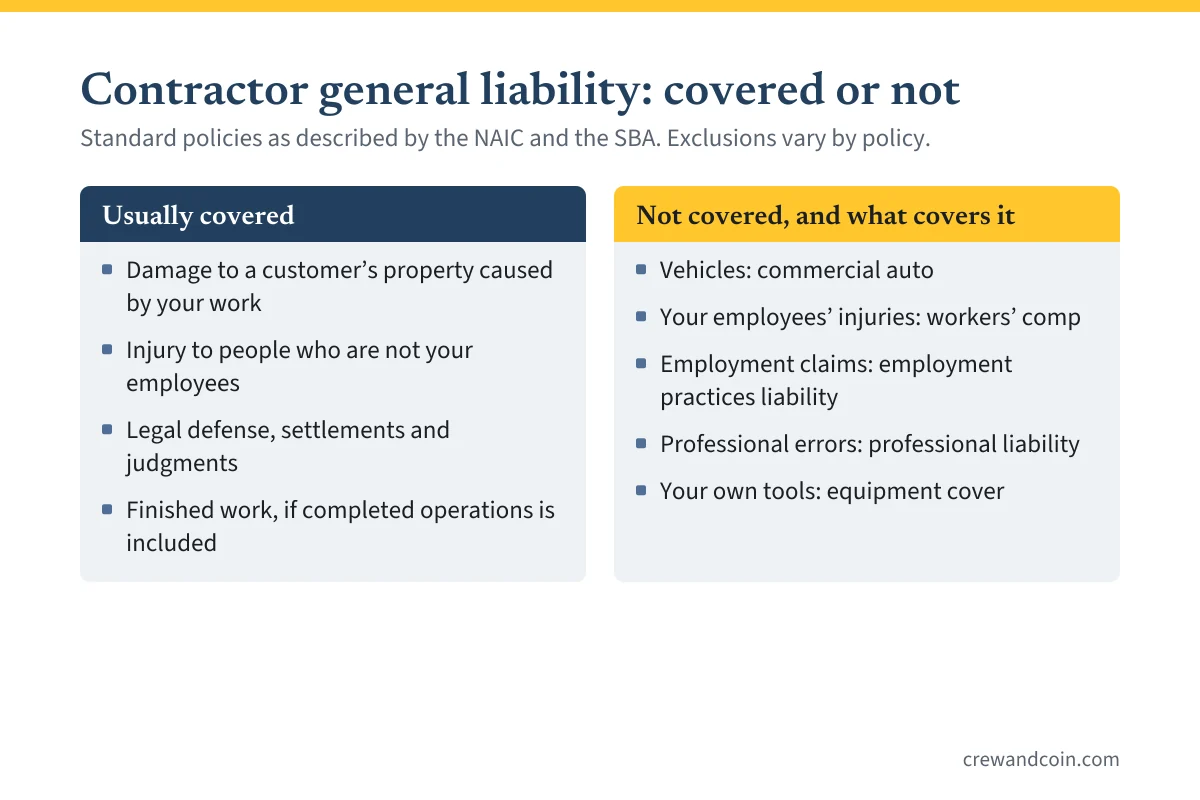
- Damage to the customer's property caused by your work, like the flooded ceiling above.
- Injury to people who are not your employees, such as a customer who trips over your extension lead.
- Legal defense if someone sues you over one of those, even if the claim turns out to be groundless.
Completed operations: the part that matters most in the trades
Most trade claims do not happen while you are on site. They happen after you have packed up and been paid. The NAIC's glossary describes completed operations liability as cover for the liability of contractors, plumbers, electricians, repair shops and similar firms, and lists products and completed operations as a sub-line of commercial general liability.
When you compare quotes, ask directly: "Does this policy include products and completed operations, and with what limit?" If the answer is not clearly yes, the policy may not cover the claims your trade is most likely to produce.
What general liability does not cover
According to the NAIC, a standard commercial general liability policy does not cover:
| Not covered | What covers it instead |
|---|---|
| Claims from operating a vehicle | Commercial auto |
| Employment claims, such as wrongful termination or harassment | Employment practices liability |
| Professional errors and omissions | Professional liability |
Two more gaps catch trade businesses out:
- Your employees' injuries. Those fall under workers' compensation, which most states require once you hire. See the guide to workers' comp for contractors.
- Your own tools, van and materials. Liability pays for harm to other people and their property. Your own equipment needs property or equipment cover.
Every policy also has its own exclusions, and they differ between insurers. Typical areas to ask about are work at height, roofing, water damage, mold, and work done by subcontractors.
Occurrence or claims-made
General liability policies come in two forms, and the difference matters once you have been in business a few years.
- Occurrence. The NAIC's glossary describes an occurrence as an accident that results, during the policy period, in injury or damage. The policy in force when the damage happened responds, even if the claim arrives years later.
- Claims-made. The NAIC describes a claims-made form as one that pays only if both the event that triggers the claim and the claim itself are submitted within the policy period. If you switch insurers or stop the policy, old work can be left without cover unless you arrange extended reporting.
For trade work, where claims often arrive long after the job, ask which form a quote uses before you compare prices.
Limits
A policy shows its limits as amounts per occurrence and in aggregate for the policy period. What you need depends less on the law than on your customers and your license:
- Customers and contracts. Commercial customers and general contractors often set a minimum in their agreements.
- License rules. Some states set minimums for certain licensees. California, for example, requires contractors licensed as LLCs to carry liability insurance with a cumulative limit of at least $1 million when five or fewer people are on the license record, plus $100,000 for each additional person, up to $5 million.
- Umbrella cover. When a contract asks for more than your policy offers, an umbrella policy adds a layer on top. The NAIC says umbrella limits typically range from $1 million to $5 million.
How the price is set
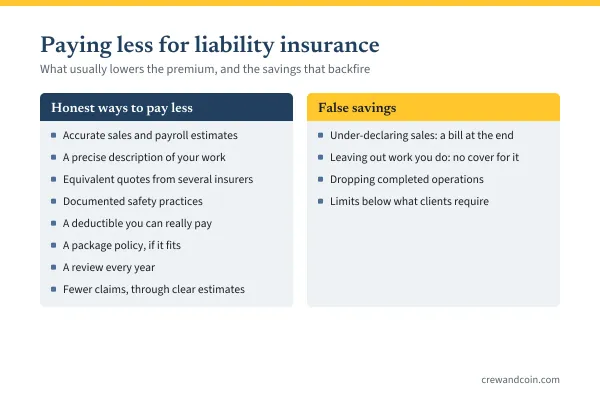
There is no official price list: each insurer sets its own rates. The NAIC explains that liability premiums are typically linked to a business's sales and payroll estimates given before the policy starts. If the real figures are higher, you may owe more; if they are lower, you may get a refund.
That has two practical consequences:
- Estimate honestly. Say you estimate $150,000 of sales and finish the year at $190,000. A low estimate gives a lower quote now and a bill later.
- Describe your work precisely. The type of work drives the rate. A handyman who also does roof repairs, or a painter who also does pressure washing, should say so. A claim from work that was never described to the insurer is the worst kind of surprise.
The NAIC also suggests comparing the cost of equivalent coverage from several insurers, making sure your agent understands your business, and keeping documented safety practices, which can help lower liability premiums.
Certificates of insurance and additional insureds
Before you start, a customer may ask for a certificate of insurance. The FTC tells homeowners to ask contractors for proof of insurance, so expect it from careful customers as well as commercial ones.
A certificate is a summary, not the policy. Texas's insurance department, for example, says a certificate may not use terms that would alter, amend or extend the coverage in the policy, and that the certificate holder box may not be used to imply or confer new or additional rights.
If a customer asks to be named as an additional insured, that has to happen in the policy. The same Texas guidance says the additional insured box should only be checked if the policy includes an endorsement naming the certificate holder. So ask your agent for the endorsement first, then the certificate.
Checklist before you sign
- Products and completed operations included, with the limit stated.
- Occurrence or claims-made form, and what happens to old work if you switch.
- Per-occurrence and aggregate limits that meet your customers' contracts and your license.
- Every kind of work you do described in the policy.
- Exclusions read: heights, roofing, water, mold, subcontractors.
- Deductible you can pay without hardship.
- The sales and payroll estimates the price is based on.
What to do next
Write down every type of work you do and your honest sales estimate for the year, then ask at least two licensed agents for quotes on the same limits and form. If you run a handyman business, the guide to handyman insurance covers the extra points that come with doing many different trades.
Frequently asked questions
What does general liability insurance cover for contractors?
Injury to people who are not your employees, damage to their property caused by your work, and the cost of defending a lawsuit. For trade work, check that it includes products and completed operations.
Does general liability cover my tools or my van?
No. According to the NAIC, standard commercial general liability excludes claims from operating a vehicle, and liability cover pays for harm to others, not damage to your own equipment. Those need commercial auto and equipment cover.
What is an additional insured?
A person or company, such as a property manager, added to your policy by an endorsement. A certificate of insurance alone cannot add them; the policy has to include the endorsement.
More on insurance

Insurance · US
General liability insurance for independent contractors
Insurance · US
Contractor insurance: the complete guide for small businesses

Insurance · US