
Insurance · US
Painting contractor insurance: cover and what drives the price
Quick answer
A painting business usually needs general liability with completed operations for overspray and damage, workers' comp for employees who work at height, tools cover for sprayers and ladders, and commercial auto. For pre-1978 homes, get EPA lead-safe certified and check your policy's lead exclusions.
This article is general information about business insurance, not insurance advice. Coverage, prices and legal requirements depend on your state or country, your trade and the insurer. Check the policy wording and your local regulator before you buy.
Picture a breezy afternoon on an exterior repaint. The sprayer drifts, and the neighbor's white car ends up with a fine mist of gray. Or a drop cloth slides on a polished floor and a helper goes down hard with a full bucket. Or the house was built in 1962 and the scraping you did yesterday may have spread lead dust. Painting looks like low-risk work from the outside. The insurance questions say otherwise.
This guide covers the insurance a painting business usually needs, the risks that are specific to the trade, and what drives the price. It is part of the complete guide to contractor insurance. It is general information: rules vary by state, insurers set their own prices, and the policy wording decides what is covered.
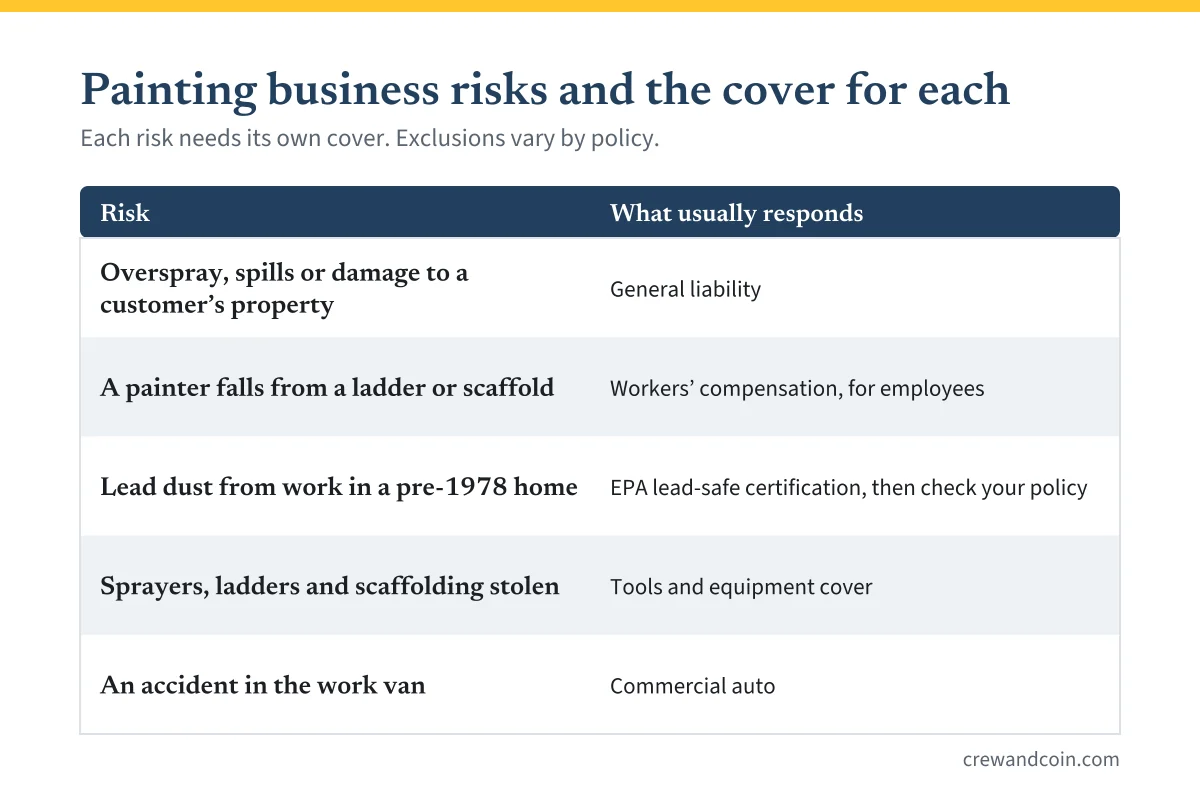
Painting risks and the cover for each
| Risk | What usually responds |
|---|---|
| Overspray, spills or damage to a customer's property | General liability |
| A painter falls from a ladder or scaffold | Workers' compensation, for employees |
| Lead dust from work in a pre-1978 home | Lead-safe certification first; then check your policy |
| Sprayers, ladders and scaffolding stolen | Tools and equipment cover |
| An accident in the work van | Commercial auto |
General liability: overspray, spills and finished work
General liability is the policy customers and property managers ask about. The SBA describes it as cover against financial loss from bodily injury, property damage, medical expenses, and defending lawsuits. For a painter, the classic claims are overspray on cars and siding, paint on carpets and furniture, and damage from ladders.
Two points matter more in painting than in many trades:
- Completed operations. The NAIC's glossary describes completed operations liability as cover for the liability of contractors for work that is finished. Peeling paint or a stain that appears weeks later is that kind of claim. Check that it is included.
- Spraying. Tell the insurer whether you spray, brush and roll, or both, and whether you work on exteriors. These change the risk, and a policy that does not describe them may not respond.
The guide to general liability insurance for contractors explains limits and exclusions in detail.
Lead paint: certification first, then the policy
Many painting jobs are in older homes. The EPA's Renovation, Repair and Painting Rule requires anyone paid to do work that disturbs painted surfaces in homes, childcare facilities and preschools built before 1978 to be certified, with employees trained in lead-safe work practices, either as certified renovators or on the job by one.
Insurance does not replace that certification. Once you have it, ask your agent two direct questions:
- Does the policy exclude claims involving lead or other pollutants?
- If it does, is there an endorsement or a separate policy that covers lead-related claims for a certified firm?
Get the answers in writing before you take pre-1978 work. The guide to bidding a paint job explains how to price the extra time lead-safe work takes.
Heights and workers' comp
Ladders, scaffolds and roof edges are where painting injuries happen. OSHA's construction standard requires protection for employees on a surface with an unprotected side or edge 6 feet or more above a lower level. Safe equipment and training are the first line; workers' comp is what pays when something goes wrong anyway.
The NAIC says nearly all states require employers to carry workers' comp, with exemptions for owners that vary by state. California requires it from the first employee; Florida requires construction employers with one or more employees to carry it. The guide to workers' comp for contractors compares the rules.
What drives the price
Insurers set their own rates, but regulators explain the basis.
General liability. The NAIC says liability premiums are typically linked to a business's sales and payroll estimates, adjusted later if the real figures differ. For painters, the type of work also matters: interior repaints, exteriors, commercial work and spraying are not priced the same.
Workers' comp. Oregon's small business ombudsman explains that each type of work is assigned a classification with its own rate, and that the premium is the projected payroll times the classification rate, divided by 100. An experience modification then adjusts it for your claims history.
Here is how that adds up for a two-painter crew, with an invented rate to show the method:
| Line | How it is worked out | Amount |
|---|---|---|
| Wages | 2 painters × $23.75 × 2,080 hours | $98,800 |
| Classification rate (example) | Per $100 of payroll | $8.00 |
| Estimated premium | $98,800 ÷ 100 × $8.00 | $7,904 |
| Per hour worked | $7,904 ÷ 4,160 hours | about $1.90 |
The wage is the BLS median for construction and maintenance painters in May 2025. The rate is only an example; ask a licensed agent for the real one in your state.
That last line belongs in your labor cost, alongside the wage and payroll taxes. The complete pricing guide shows where it fits.
Tools, sprayers and the van
Airless sprayers, extension ladders and scaffold sections are expensive and easy to steal from a job site. General liability does not cover your own equipment. The NAIC's glossary describes inland marine insurance as coverage for property in transit, held by others or at a fixed location, which is how many insurers cover contractors' tools. Ask whether it covers theft from a locked vehicle and from job sites.
For the van, the NAIC warns that business-related liability may be excluded from a personal auto policy, and general liability excludes vehicles. The guide to commercial auto insurance for contractors covers what to ask.
License and bond
Some states license painters, and the license can bring its own requirements. California, for example, requires a contractor license for work valued at $1,000 or more in labor and materials, and a $25,000 contractor bond for an active license. The guide to starting a painting business covers licensing in more detail, and the guide to contractor bonds explains how bonds work.
Checklist before you buy
- General liability with products and completed operations.
- Spraying, exteriors and commercial work described, if you do them.
- A clear answer, in writing, on lead and pollution exclusions.
- Workers' comp in place before the first employee starts.
- Tools cover for sprayers, ladders and scaffolding.
- Commercial auto, or written confirmation that your auto policy covers business use.
- Any bond or insurance your state license requires.
What to do next
List the kinds of painting you do, check whether you work on pre-1978 homes and whether you are lead-safe certified, then ask at least two licensed agents for quotes on the same cover. If the price seems high, the guide on how to pay less for contractor liability insurance covers what you can change.
Frequently asked questions
What insurance does a painting contractor need?
Usually general liability with completed operations, workers' comp once there are employees, tools cover for sprayers and ladders, commercial auto for the work van, and any bond or insurance the state license requires.
Does general liability cover overspray damage?
Damage to other people's property caused by your work is what general liability is for, but policies differ. Tell the insurer you spray, especially on exteriors, so the policy describes the work you do.
Do painters need lead certification for insurance?
Certification is a legal requirement, not an insurance one: the EPA requires firms paid to disturb paint in pre-1978 homes to be certified. Then ask your insurer whether the policy excludes lead-related claims.
More on insurance

Insurance · US
General liability insurance for contractors: cover and costs

Insurance · US
Handyman insurance: what you need and what it costs
Insurance · US
Contractor insurance: the complete guide for small businesses
Sources
- SBA: Get business insurance
- NAIC: Glossary of insurance terms
- EPA: Lead Renovation, Repair and Painting Program
- OSHA: 29 CFR 1926.501, Duty to have fall protection
- NAIC: Small business insurance
- California Department of Industrial Relations: Workers' compensation FAQs
- Florida Division of Workers' Compensation: Coverage requirements
- Oregon DCBS Small Business Ombudsman: How much does it cost?
- BLS Occupational Outlook Handbook: Painters, construction and maintenance
- CSLB: What kind of contractor do you need?
- CSLB: Bond requirements