
Insurance · US
Handyman insurance: what you need and what it costs
Quick answer
A handyman business usually needs general liability with completed operations, cover for its tools, commercial auto or written confirmation that the work vehicle is covered, and workers' comp once it hires. Check your state's license limits first, and describe every type of work to the insurer.
This article is general information about business insurance, not insurance advice. Coverage, prices and legal requirements depend on your state or country, your trade and the insurer. Check the policy wording and your local regulator before you buy.
A handyman's week can include hanging a television, fixing a running toilet, patching drywall, replacing a light fixture and re-hanging a gate. That variety is the appeal of the trade, and it is also what makes insuring it harder than insuring a business that does one thing. Each task carries a different risk, and an insurer can only cover the work it knows about.
This guide covers the insurance a handyman business usually needs, in the order most owners buy it, and the points that are specific to doing many small jobs in other people's homes. For the full picture of each type of cover, see the complete guide to contractor insurance. This is general information: rules vary by state, and the policy wording decides what is covered.
Start with what you are allowed to do
Before insurance, check licensing, because it shapes what you can insure. The rules differ by state. In California, for example, the Contractors State License Board requires a license for work valued at $1,000 or more in combined labor and materials, for any project that needs a building permit, and for anyone who uses employees. Many handymen work under that limit; once a business goes above it, the license brings its own requirements, such as California's $25,000 contractor bond.
The guide to starting a handyman business covers the licensing side in more detail. For insurance, the point is simple: describe to your insurer only the work you are allowed to do, and do only the work you have described.
1. General liability, with completed operations
This is the first policy for almost every handyman. The SBA describes general liability as cover against financial loss from bodily injury, property damage, medical expenses and lawsuits. In a handyman business, the typical claim is not dramatic: a shelf that comes down a week later, a leak from a fitting, a scratched floor.
Many of those claims arrive after the job is finished, which is why completed operations matters. The NAIC's glossary describes completed operations liability as cover for the liability of contractors, plumbers, electricians, repair shops and similar firms. Check that your policy includes it.
When you apply, list every kind of work you do, including the occasional ones. If you sometimes go on roofs, clean gutters or do small electrical swaps, say so. A policy that describes you as doing "interior repairs" may not respond to a claim from a roof.
The guide to general liability insurance for contractors explains limits, exclusions and how to read a quote.
2. Cover for your tools
A handyman's van holds tools for a dozen trades, and they are worth more than most people add up. General liability does not cover your own equipment. The NAIC's glossary describes inland marine insurance as coverage for property that may be in transit, held by someone else or at a fixed location, which is how many insurers cover contractors' tools.
Questions to ask before you buy:
- Does it cover theft from a locked vehicle, and overnight?
- Does it cover tools on a customer's property while you work?
- Does it pay what it costs to replace the tool, or its depreciated value?
- Is there a limit per item?
3. Commercial auto, or written confirmation
Your van carries tools and materials to every job. The NAIC warns that business-related liability may be excluded from a personal auto policy, and that a standard general liability policy excludes claims from operating a vehicle. Either buy commercial auto cover, or get written confirmation from your auto insurer that the way you use the vehicle is covered.
4. Workers' comp when you hire
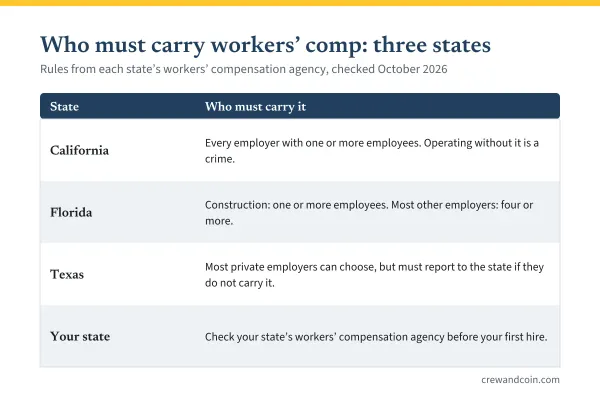
A handyman working alone is often outside workers' comp rules, but that changes with the first helper. The NAIC notes that nearly all states require employers to carry it, with exemptions for owners and independent contractors that vary by state. California, for example, requires it from the first employee. The guide to workers' comp for contractors compares the rules in three states and explains how the premium is calculated.

Certificates for property managers
Property managers and real estate agents are some of the best customers a handyman can have: steady, small jobs across many homes. They will usually ask for a certificate of insurance and sometimes to be named as an additional insured. Remember that a certificate only summarizes your policy. Texas's insurance department, for example, says a certificate may not alter, amend or extend coverage, and that additional insured status requires an endorsement in the policy. Ask your agent for the endorsement, then the certificate.
Putting insurance into your hourly rate
Every policy is a fixed cost, paid whether or not the phone rings. Spread it across the hours you actually bill.
Say your policies add up to $2,400 a year and you bill about 30 hours a week for 52 weeks, which is 1,560 hours. Insurance then costs $1.54 per billable hour. It is not much on its own, but it belongs in your overhead with the van, the phone and the tools. The guide to setting a handyman hourly rate shows where it fits. The $2,400 is an example; use your own quotes.
Common mistakes
- Describing the business too narrowly to get a cheaper quote.
- Assuming general liability covers stolen tools.
- Driving to jobs on a personal auto policy without asking the insurer.
- Letting a helper start before workers' comp is in place.
- Taking work above your state's license limit, which the policy may not expect either.
What to do next
Write down every type of job you did in the last three months, check your state's license limits, and ask at least two licensed agents for quotes on general liability with completed operations and tools cover. Then add the yearly cost to your overhead before you set your next price.
Frequently asked questions
What insurance does a handyman need?
Usually general liability with completed operations, tools cover, commercial auto or confirmation that the work vehicle is covered, and workers' comp once there are employees. Some states also require a bond for licensed contractors.
Does handyman liability insurance cover my tools?
No. General liability covers harm to other people and their property. Your own tools need separate cover, often called inland marine or tools and equipment cover.
Do I need a license to get handyman insurance?
Not always, but licensing affects what work you can legally do and insure. In California, for example, a license is required for jobs of $1,000 or more in labor and materials. Check your state's rules.
More on insurance

Insurance · US
Painting contractor insurance: cover and what drives the price
Insurance · US
Workers' comp for contractors: when you need it and what it costs

Insurance · US