Insurance · US
How to pay less for contractor liability insurance
Quick answer
Liability premiums follow your sales and payroll estimates, type of work and claims history. To pay less, give accurate estimates, describe your work precisely, compare equivalent cover, document safety practices, choose an affordable deductible, consider a package and review the policy every year.
This article is general information about business insurance, not insurance advice. Coverage, prices and legal requirements depend on your state or country, your trade and the insurer. Check the policy wording and your local regulator before you buy.
Say the renewal notice arrives and your liability premium has gone up again. Nothing went wrong: no claims, same work, same truck. The first instinct is to cut cover or find the cheapest policy online. Both can cost far more than they save if the cheaper policy does not pay when a customer's floor is ruined.
There are honest ways to pay less, and almost all of them come from understanding how the price is built. This guide explains what drives a contractor's liability premium, the changes that usually lower it, and the "savings" that tend to backfire. It is part of the complete guide to contractor insurance, and it is general information: insurers set their own rates and rules vary by state.
What the price is built from
The NAIC, the national association of state insurance regulators, explains that liability insurance premiums are typically linked to a business's sales and payroll estimates given before the policy starts. If the real figures turn out higher, you may owe more; if they are lower, you may get money back.
On top of that, insurers look at:
- The type of work. Roofing, spraying and work at height are priced differently from interior handyman jobs.
- Your safety and claims record. As point 4 below shows, regulators note that documented safety practices can help lower premiums.
- The cover you choose. Limits, deductible, form and endorsements all change the premium.
Every change below works on one of those.
Eight honest ways to lower the premium
1. Give accurate estimates
Because the price follows your sales and payroll estimates, an inflated estimate means paying for business you never did, until the end-of-policy adjustment. A low estimate does the opposite: a cheaper quote now and a bill later. Use last year's figures and your real plans.
2. Describe your work precisely
Each type of work carries its own risk. Write down exactly what you do. If you stopped doing roof work two years ago, make sure it is no longer on the policy. If you only do interiors, say so. The aim is a description that is accurate, not a short one: leaving out work you do can leave you without cover when a claim comes from it.
3. Compare equivalent cover from several insurers
The NAIC suggests comparing the cost of equivalent coverage from several insurers, and making sure your agent is familiar with your business. "Equivalent" is the key word: give every agent the same limits, form, deductible and description, or you are comparing different policies.
4. Document your safety practices
The NAIC notes that documented safety practices can help lower liability premiums. For a trade business, that can mean written procedures for ladders and drop cloths, a site-protection checklist, photos before and after each job, and training records. Show them to your agent at renewal.
5. Choose a deductible you can really pay
For vehicles, the NAIC says you may reduce auto insurance costs by raising the deductible on physical damage, as long as you can afford to absorb a larger part of a loss. For liability policies, ask your agent whether deductible options exist and how much each one changes the price. Pick one you could pay from the business account tomorrow.
6. Look at a package
The SBA describes a business owner's policy as a package that combines typical coverage into one bundle and can save money. The NAIC adds that a BOP typically includes property, business interruption and liability insurance, but not commercial auto or workers' comp. If you have a shop, storage unit or equipment worth insuring, ask for a BOP quote alongside a standalone liability quote.
7. Review the policy every year
The NAIC suggests reviewing all insurance policies annually, and telling your insurer when circumstances change. If your sales fell, you stopped a type of work or you sold a vehicle, the basis of your premium has changed. Ask for it to be updated.
8. Keep claims small by preventing them
Claims can weigh on your renewal, and many trade claims start with avoidable problems: unprotected floors, overspray, a disagreement about what was included. A written scope and clear exclusions on every estimate, as the guide to writing a job estimate explains, stop many disputes before they become claims.
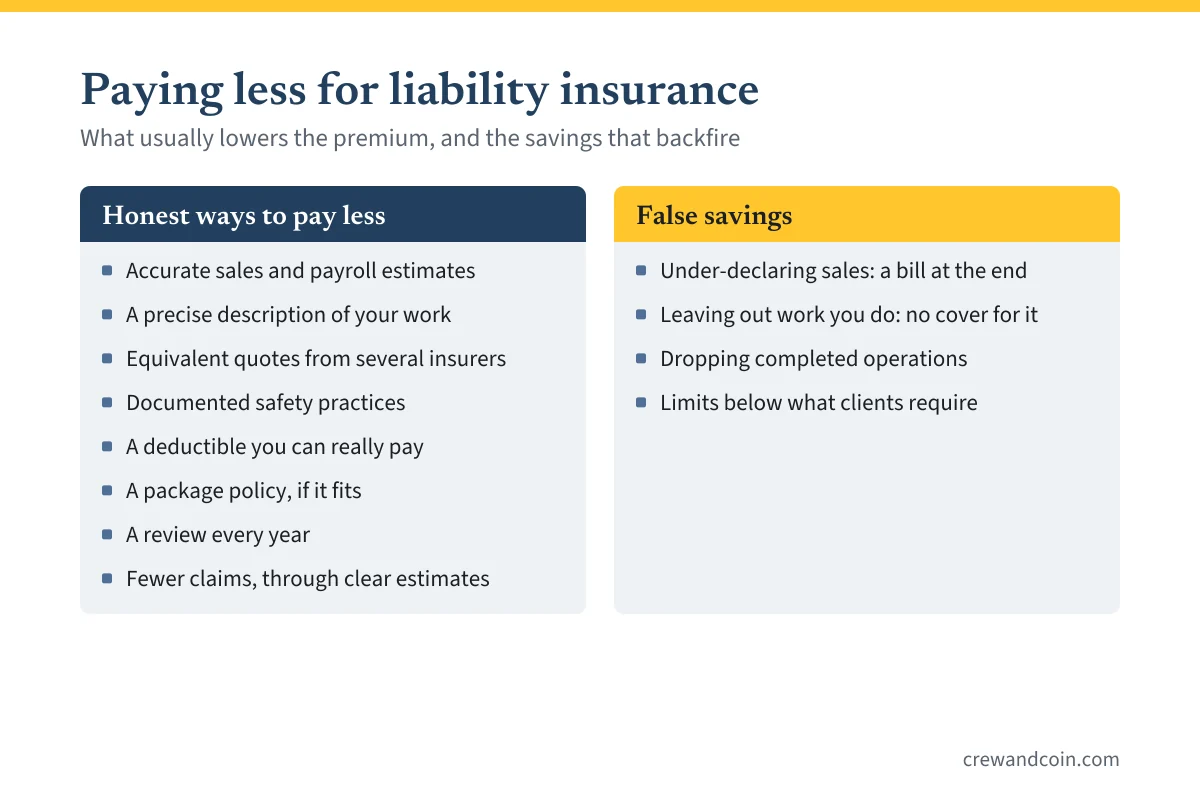
False savings that backfire
| "Saving" | Why it backfires |
|---|---|
| Under-declaring sales | The end-of-policy adjustment sends a bill for the difference |
| Leaving out work you do | A claim from that work may not be covered |
| Dropping completed operations | Most trade claims arrive after the job is finished |
| Limits below what your clients require | You lose work that needs higher limits |
A policy that is cheap because it does not fit your work is not cheap. It is a policy you pay for and cannot use.
How much of the price can you really change?
Some of it, not all of it. The type of work, your state and the insurer's own rates set the starting point. What you control is the accuracy of the information, the cover you choose, your claims history and how carefully you shop. Over a few years, a clean record and an accurate, well-documented application usually do more than any single trick.
Whatever you end up paying, put it in your prices. Insurance is overhead, and the complete pricing guide shows how to spread it across your billable hours, so the customer pays for it, not your wage.
What to do next
Pull last year's sales and payroll, list every type of work you did, and gather your safety documents. Then ask your current agent and at least one other for quotes on the same cover. If your trade is painting, the guide to painting contractor insurance covers the risks insurers ask about most.
Frequently asked questions
How can a contractor lower general liability insurance costs?
Give accurate sales and payroll estimates, describe your work precisely, compare equivalent cover from several insurers, document safety practices, choose an affordable deductible and review the policy every year.
Is the cheapest contractor insurance a good idea?
Only if it covers the work you actually do with the limits your clients require. A cheaper policy that leaves out completed operations or part of your work can leave you paying claims yourself.
Why did my liability premium go up at the end of the year?
Liability premiums are usually based on estimated sales and payroll. If the real figures were higher, the insurer can charge the difference after the policy ends.