Pricing
How to write a job estimate customers accept
Quick answer
A written estimate needs nine parts: your details, the customer and job address, scope of work, exclusions, materials, schedule, price, payment terms, and how long the price is valid and how changes are agreed. Say clearly whether the price is fixed or an estimate.
On this page
- Estimate, quote or bid: say which one you mean
- What customers are told to look for
- The nine parts of an estimate
- Write the scope so it cannot be misread
- How much of the price to show
- Payment terms, validity and changes
- A sample estimate you can adapt
- Send it fast, then follow up
- Five mistakes that cost jobs
- What to do next
Picture two estimates landing in the same inbox on a Tuesday night. One says "Paint two bedrooms: $1,870." The other says which rooms, which surfaces, how many coats, which paint, what the painter will repair first, when the work starts and how payment works. The second one costs the same. It is also the one that gets a reply, because the customer can see what the money buys.
Working out the number is covered in the complete pricing guide. This guide is about the page the number sits on: what to put in a written estimate, how to word it and what to do after you press send.
Estimate, quote or bid: say which one you mean
In everyday use the three words overlap. An estimate is usually an informed guess that can move once the work is opened up. A quote is usually a fixed price for a fixed scope. A bid is usually a price offered in competition with others, often for commercial work.
Customers do not know these habits, and how binding a document is depends on your state's law and on what the document itself says. So do not rely on the title. Write one plain sentence near the price:
- "This is a fixed price for the work listed above."
- "This is an estimate. The final price depends on what we find behind the trim, and we will agree any change in writing before doing it."
That sentence prevents more arguments than any other line on the page.
What customers are told to look for
You do not have to guess what a careful customer expects. The Federal Trade Commission tells homeowners what a written estimate should include: a description of the work to be done, materials, completion date and the price. It also tells them not to pick the lowest bid automatically and to ask for an explanation when prices differ a lot.
That advice works in your favor. A customer who has read it is looking for a reason to trust a higher price. A detailed estimate is that reason.
The FTC also lists what the written contract for a home improvement job should contain: the contractor's name, address, phone number and license number, an estimated start and completion date, and any promises made in conversations about the scope of work and the cost of labor and materials. If your estimate already carries all of that, it turns into the agreement with a signature.
The nine parts of an estimate
| Part | What to write | Why it matters |
|---|---|---|
| Your details | Business name, address, phone, email, license number where you need one | The first thing a careful customer checks |
| Customer and job address | Name, address of the work, date of the estimate | Avoids mix-ups when you send several a week |
| Scope of work | Each area and task, in plain words | Sets what is included |
| Exclusions | What is not included | Sets what is not, before it becomes an argument |
| Materials | Brand, product line, color or finish, who supplies them | Lets the customer compare like with like |
| Schedule | Estimated start date and how long the work takes | The FTC tells customers to look for it |
| Price | Total, plus options if you offer them | The number, with nothing hidden under it |
| Payment terms | Deposit, when the balance is due, how to pay | Protects your cash flow |
| Validity and changes | How long the price holds; how changes are agreed | Protects you from old prices and scope creep |
Write the scope so it cannot be misread
Most disputes start with a scope that two people read differently. Compare these two lines:
Vague: "Paint bedrooms."
Clear: "Two upstairs bedrooms. Walls and ceilings: fill nail holes and small cracks, sand, spot-prime repairs, two coats. Baseboards, door frames and two doors: one coat of semi-gloss. Closets not included."
The clear version takes two more minutes to write. It tells the customer what they are getting, and it tells your crew what to do when you are not on site.
Exclusions deserve their own short list. Typical ones are moving heavy furniture, repairing damage found after work starts, and anything behind or under what you were asked to work on. If a hidden problem is likely, say how it will be priced: "Rotten wood, if found, is repaired at $X per hour plus materials, after you approve it."
How much of the price to show
Show the customer what they are buying, not how you built the number. Your labor rate, overhead share and margin belong on your worksheet, not on the estimate. A line-by-line cost breakdown invites the customer to negotiate each line, and it hands your pricing to the next contractor they show it to.
What does help is splitting the price by things the customer can choose:
| Option | What it includes | Price |
|---|---|---|
| Walls and ceilings | Both bedrooms, two coats | $1,490 |
| Add trim and doors | Baseboards, frames, two doors | $380 |
| Both | $1,870 |
Now a customer on a tight budget can say yes to part of the job instead of saying no to all of it. I'd offer two or three options on almost every estimate, and never more than three.
Payment terms, validity and changes
Three short lines save a lot of chasing later.
- Deposit and balance. Say how much is due to book the job and when the rest is due. Keep it reasonable: the FTC tells consumers not to pay the full amount up front and never to make the final payment until the work is done and they are satisfied. It also notes that some states limit how much a contractor can ask as a down payment, so check your state's rule before you set yours.
- Validity. Paint, lumber and fuel prices move. "This price is valid for 30 days" is enough.
- Changes. "Any change to the work listed here will be priced and agreed in writing before it is done." Then actually do it, even by text message.
A sample estimate you can adapt
Here is the two-bedroom repaint from the pricing guide, written the way the customer should receive it. The figures are an example.
Estimate for interior painting
Prepared for: [customer name], [job address]. Date: [date]. From: [business name, address, phone, license number].
Scope of work. Two upstairs bedrooms. Walls and ceilings: fill nail holes and small cracks, sand, spot-prime repairs, two coats. Baseboards, door frames and two doors: one coat of semi-gloss. Floors and furniture covered; rooms left clean.
Not included. Closets. Moving heavy furniture. Repairs to damage found after work starts, which we will price and agree with you first.
Materials. [Brand and product line], eggshell on walls, flat on ceilings, semi-gloss on trim. Colors chosen by you before the start date. All materials supplied by us.
Schedule. Estimated start: week of [date]. Two working days.
Price. $1,870, fixed for the work listed above.
Payment. $370 deposit to book the dates. Balance of $1,500 due when the work is finished and you have walked through it with us.
Valid for 30 days. Changes to this work are priced and agreed in writing before they are done.
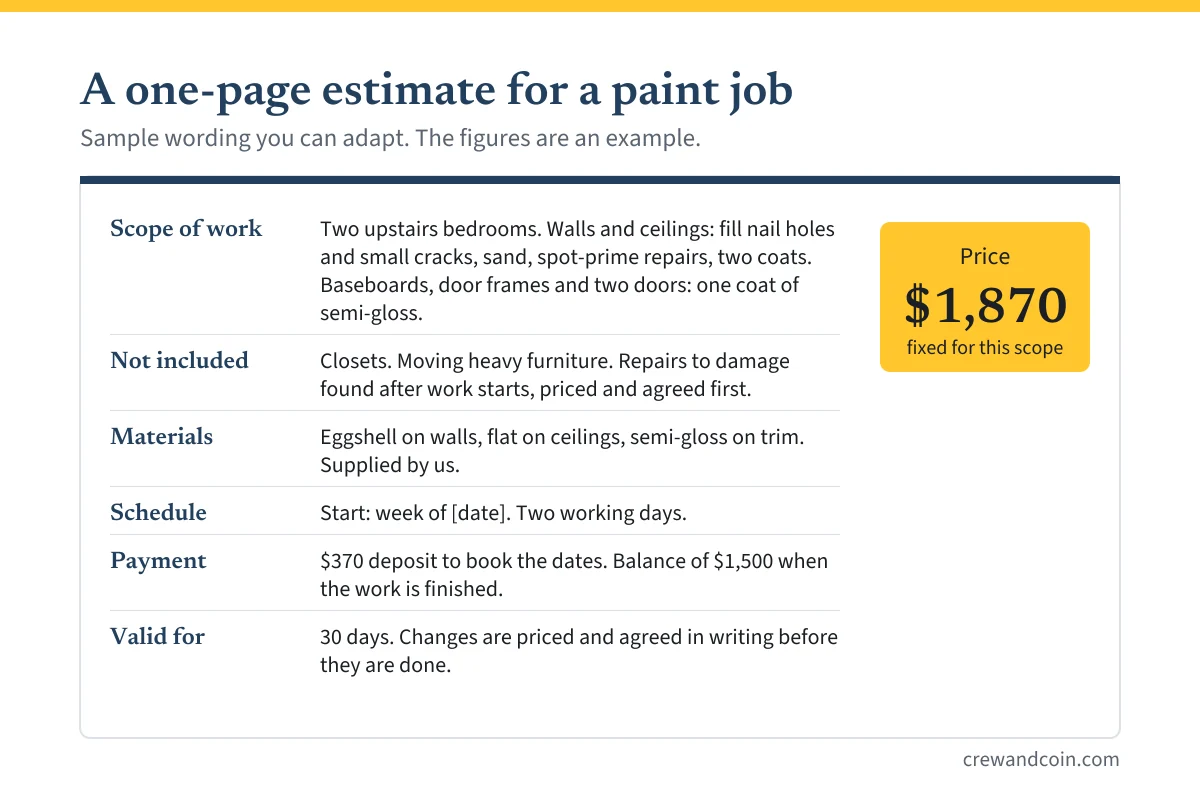
It fits on one page and has no jargon. A customer can read it in two minutes and knows what happens next.
Send it fast, then follow up
A good estimate that arrives late still loses to an average one that arrived first. Aim to send it the same day you see the job, while the conversation is fresh. A saved template with your details, standard exclusions and terms makes that realistic, because you only write the scope and the price.
Then follow up. A simple plan:
- Same day: send the estimate with two lines summarizing what you discussed.
- Two days later: a short message asking if they have questions.
- One week later: one last note saying when your calendar fills up.
A mistake a lot of owners make is treating silence as a no. Often the customer just got busy.
Five mistakes that cost jobs
- A one-line scope that leaves the customer guessing.
- No exclusions, so every surprise becomes your cost.
- Showing your hourly rate and margin, then defending them line by line.
- No expiry date on the price.
- Sending the estimate three days after the visit.
What to do next
Build your template once, with the nine parts above, and reuse it for every job. To check the number before it goes on the page, run it through the job price calculator. If your profit target is a percentage, read markup vs margin first, and for painting work the guide to bidding a paint job shows how to get from measurements to the total.
Frequently asked questions
What is the difference between an estimate and a quote?
In everyday use, an estimate is an informed guess that can change and a quote is a fixed price for a fixed scope. How binding either one is depends on your state's law and on the wording, so state on the document whether the price is fixed.
Should I show my hourly rate on an estimate?
For fixed-price work it is usually better to show what the customer is buying, split into options they can choose, and keep your labor rate, overhead and margin on your own worksheet.
How long should an estimate be valid?
Long enough for the customer to decide and short enough that material prices have not moved. Thirty days is a common choice; write the period on the estimate.