Pricing
Busy but not profitable: why and how to fix it
Quick answer
A busy trade business that makes little money is usually underpriced: hidden hours, the owner's pay, small jobs, driving and free extras are missing from the price. Work out your break-even in jobs: fixed costs divided by price minus variable costs per job.
Picture a month where the calendar is full, the phone keeps ringing, you work most Saturdays, and when you sit down with the bank statement there is barely more in the account than four weeks ago. Being busy and being profitable are two different things, and a full schedule can hide the gap for a long time.
The good news is that the causes are few and each one leaves a trace you can check in an evening. This guide goes through the six most common ones, with a quick test for each and where to fix it. If you have never built your prices from your costs, read the complete pricing guide alongside it, because most of the fixes lead back there.
First, find out how big the problem is
Before looking for causes, put four numbers from last month on one page:
- Revenue: everything you invoiced.
- Job costs: wages for the hours worked, materials, fuel, disposal.
- Overhead: insurance, vehicle, phone, software, advertising, accounting.
- Your own pay: what you would have to pay someone else to do the hours you worked.
Revenue minus the other three is your profit. A lot of owners skip the fourth line, see money left over and call it profit. If what is left would not cover a fair wage for your own hours, the business is not making a profit. It is paying you less than a job would.
The number that explains most of it: break-even
The SBA gives a simple formula for the point where a business stops losing money:
Break-even point in units = fixed costs ÷ (price − variable costs)
For a trade business, a "unit" is a job. Take an example with $2,400 of monthly overhead, an average job price of $450 and $290 of labor and materials per job. Each job leaves $450 − $290 = $160 to pay the overhead.
- Break-even: $2,400 ÷ $160 = 15 jobs a month
- At 18 jobs: 3 jobs past break-even × $160 = $480 of profit
Eighteen jobs is a busy month for a small crew, and it produced $480. That is what busy but not profitable looks like in numbers: almost every job you did went to paying the bills, and only the last three paid the business.
Now raise the price 10 percent, to $495, and change nothing else. Each job leaves $205.
- Break-even: $2,400 ÷ $205 = 11.7, so 12 jobs
- At the same 18 jobs: 18 × $205 − $2,400 = $1,290 of profit
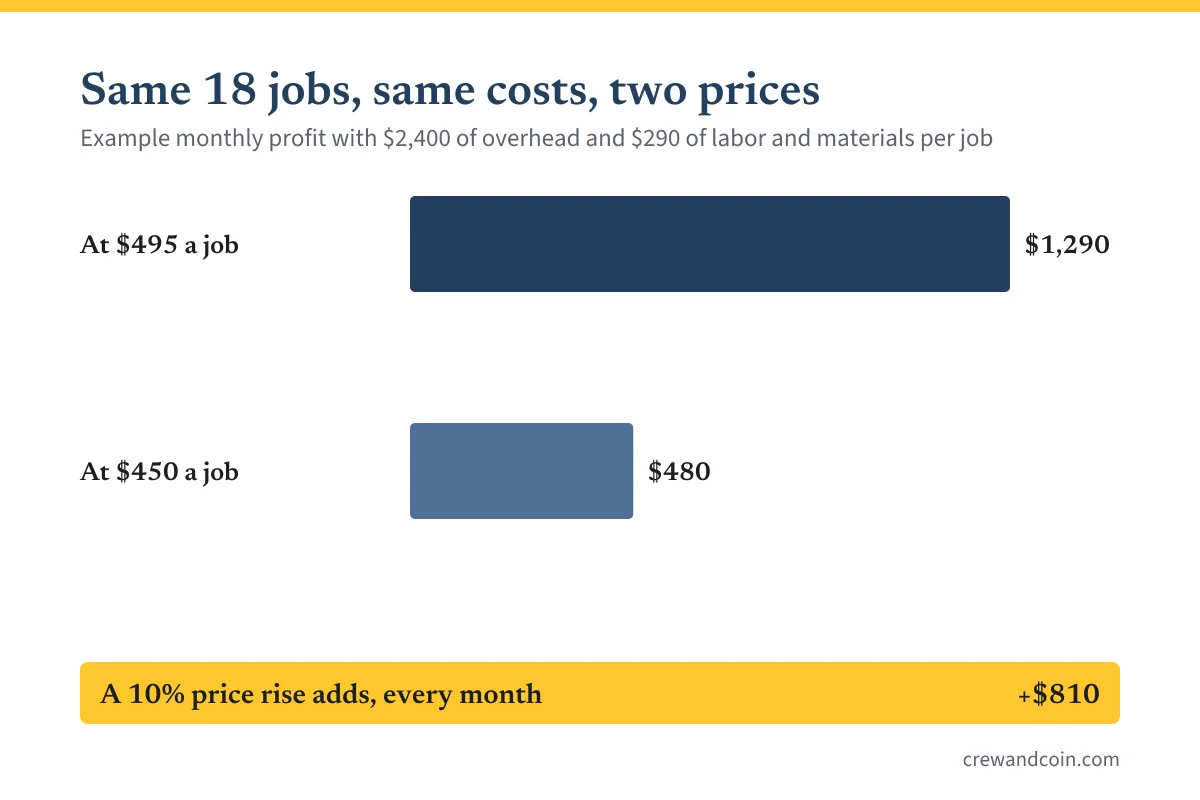
The same work, the same month, and profit goes from $480 to $1,290. A small price change moves profit far more than it moves the price, because the costs stay where they were. The SBA notes that a break-even calculation is an estimate, not an exact picture of your accounts, and suggests adding about 10 percent for expenses you cannot predict. Even as an estimate, it shows where the lever is.
Six causes, and how to test each one
| Symptom | Likely cause | Quick test |
|---|---|---|
| Every job seems to take longer than quoted | Hidden hours are not in the price | Time three jobs door to door |
| Money left over, but less than a wage | Your own pay is not counted as a cost | Add the fourth line above |
| Lots of small calls, little to show for it | No minimum charge | Count jobs under two hours last month |
| Long days, few invoices | Too much driving | Add up miles and hours on the road for a week |
| Target margin never shows up in the accounts | Markup used as margin | Check how you add profit to a quote |
| Jobs grow after the price is agreed | Free extras | List what you did last month and did not bill |
1. The price only covers the hours on site
The customer sees four hours of work. You paid for the drive, the supplier stop, loading, setup and cleanup. If those hours are not in the price, you work them for free on every job. Test: time three jobs from leaving the shop to getting back, and compare with the hours you priced. Fix: price the full time, not the visible time.
2. Your own pay is treated as the profit
If you work in the business, your wage is a labor cost like anyone else's. Test: put an hourly figure on your own hours and subtract it. Fix: build your pay into your hourly cost before you add margin.
3. Small jobs with no floor
A 20-minute repair still needs the trip, the setup and the invoice. Test: count how many of last month's jobs took under two hours in total, and what each one earned. Fix: a clear minimum job charge, stated before you leave the shop.
4. The route eats the day
Two jobs 40 minutes apart cost you 80 minutes of paid time that nobody is billed for. Test: track miles and driving hours for one week. Fix: group jobs by area and by day, set a service area, and add a trip charge beyond it.
5. A markup where you meant a margin
Adding 20 percent to your costs does not leave 20 percent of the price as profit. It leaves 16.7 percent. Test: look at your last quote and see whether you multiplied the cost or divided it. Fix: divide cost by one minus the margin, as explained in markup vs margin.
6. Work you do and never bill
"While you're here, could you also…" is the most expensive sentence in the trades. Test: write down every extra from last month that did not reach an invoice. Fix: a written scope and a change line on every estimate. The guide to writing a job estimate has the wording.
Why doing more work does not fix it
The instinct when money is tight is to take more jobs. If each job is priced below what it costs, more jobs means more losses, more wear on the equipment and less time to find the problem.
I'd do the opposite for one month: take the same number of jobs, fix the price on every new quote and watch the break-even number. A business that is already full has the strongest position it will ever have to raise prices, because losing the few customers who only came for the low price frees up time for better ones.
What to do next
Put last month's four numbers on a page tonight, then work out your break-even in jobs. Run your next three quotes through the job price calculator and compare them with what you would have charged before. If the gap is large, you have found the reason for the full calendar and the empty account.
Frequently asked questions
Why is my business busy but not making money?
Most often because prices do not cover the full cost of each job: unbilled hours, the owner's own pay, overhead and profit. More work at those prices adds revenue but very little profit.
How do I calculate my break-even point?
The SBA formula is fixed costs divided by price minus variable costs per unit. With $2,400 of monthly overhead, a $450 average job and $290 of job costs, break-even is 15 jobs a month.
Should I take more jobs or raise prices?
If jobs are priced below their real cost, more jobs make the problem bigger. Fix the price on new quotes first; a small increase raises profit much more than it raises the price.