Pricing
Minimum job charge: how to set yours and explain it
Quick answer
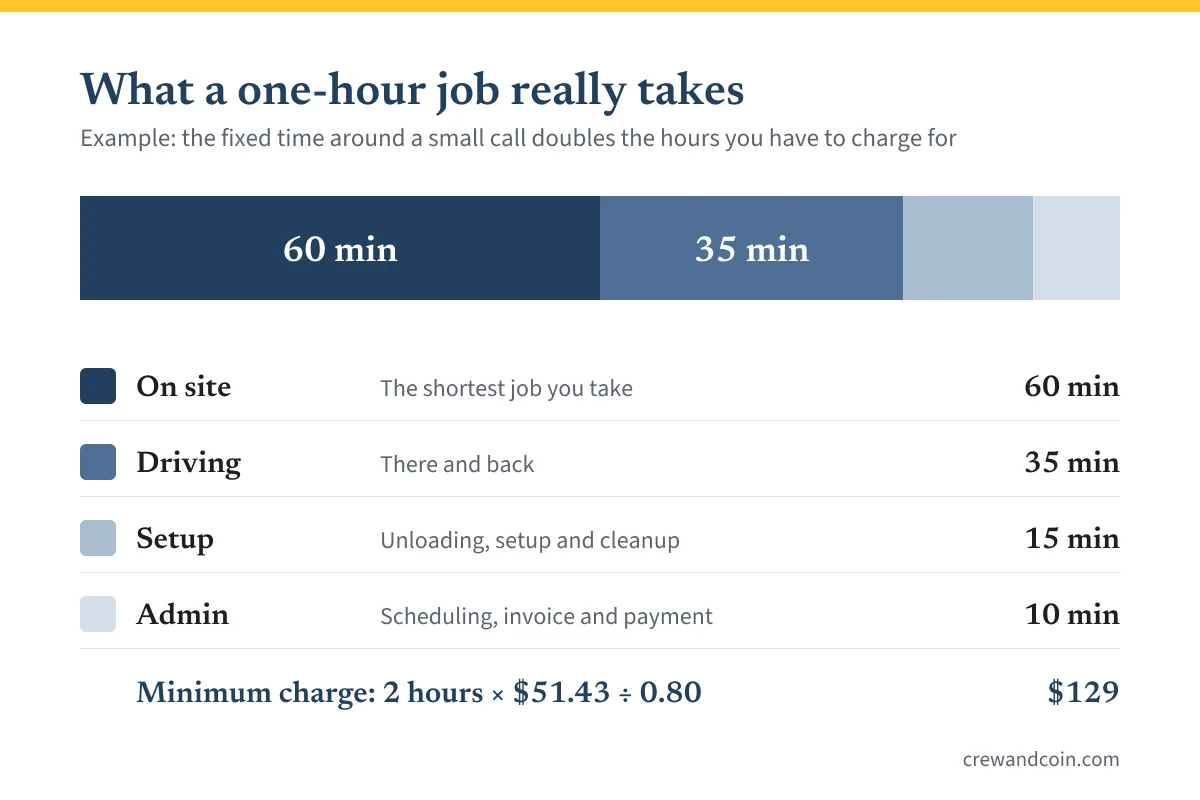
Add the shortest time you spend on site to the fixed time every visit takes (driving, setup, invoicing), multiply by your cost per hour and divide by one minus your margin. With $51.43 an hour, two hours and a 20% margin, the minimum is $129.
Say a customer calls about a dripping outdoor faucet. Twenty minutes of work, a $6 part. You charge $75 because it feels fair for twenty minutes. Then count what the job really took: the drive there and back, finding parking, unloading, the chat at the door, writing the invoice and chasing the payment. Two hours of your day are gone, and $75 did not pay for them.
A minimum job charge fixes that. It is the lowest price you accept for showing up, however small the task. This guide shows how to calculate yours from your own costs, the different ways to present it and the words to use when a customer asks why a small job costs that much.
Why small jobs lose money
Every job has two kinds of time. The time on site grows with the size of the job. The time around it does not: a ten-minute fix and a four-hour repair need the same drive, the same setup and the same invoice.
On a large job that fixed time is a small slice of the price. On a small job it is most of the cost. That is why a business can be busy all week with small calls and have nothing left at the end of the month. If that sounds familiar, the cause is usually in the method, and the complete pricing guide covers it from the start.
The formula
You need three numbers you should already have from pricing your normal work:
- Your cost per hour: labor plus the overhead each billable hour has to carry.
- Your fixed time per visit: driving, setup, cleanup and admin for a typical small call.
- Your profit margin: the share of the price the business keeps.
Then:
Minimum charge = (shortest time on site + fixed time per visit) × cost per hour ÷ (1 − margin)
Materials go on top.
A worked example
Take the example numbers from the pricing guide: labor at $31.43 an hour and $20 of overhead per billable hour, so $51.43 per hour of cost, with a 20 percent margin.
Now time a typical small call:
| Fixed time per visit | Minutes |
|---|---|
| Driving there and back | 35 |
| Unloading, setup and cleanup | 15 |
| Scheduling, invoice and payment | 10 |
| Total | 60 |
Assume the shortest job you take still needs an hour on site once you count the diagnosis and the test at the end.
| Line | How it is worked out | Amount |
|---|---|---|
| Time | 1 hour on site + 1 hour fixed | 2 h |
| Cost | 2 h × $51.43 | $102.86 |
| Price at 20 % margin | $102.86 ÷ 0.80 | $128.57 |
| Minimum charge | Rounded | $129 |
Go back to the dripping faucet at $75. The job cost $102.86 before the part, so it lost about $28. Five calls like that a week lose $139. Over 50 working weeks that is close to $7,000 a year, paid out of your own pocket for the privilege of being busy.
The division by 0.80 instead of adding 20 percent is deliberate. The reason is in markup vs margin.
How the fixed time changes the number
The fixed time per visit is the figure that moves your minimum most. With the same $51.43 an hour, one hour on site and a 20 percent margin:
| Fixed time per visit | Total time | Cost | Minimum charge |
|---|---|---|---|
| 30 minutes | 1.5 h | $77.15 | $96 |
| 60 minutes | 2 h | $102.86 | $129 |
| 90 minutes | 2.5 h | $128.58 | $161 |
A business that works a tight area can charge a lower minimum than one that drives across the county, and still make more. If your minimum looks too high for your market, shrinking the service area is often a better fix than cutting the price.
Four ways to present it
The math is the same. What changes is how the customer hears it.
| Format | How it sounds | Fits best |
|---|---|---|
| Minimum charge | "Our minimum is $129, which covers the first hour on site." | Handyman, repairs, pressure washing |
| Service call fee plus hourly | "$65 to come out, then $68 an hour." | Diagnosis work where the scope is unknown |
| Minimum hours | "We book a two-hour minimum." | Hourly trades, cleaning |
| Minimum per visit | "Visits start at $55." | Lawn care, recurring routes |
Pick one and use it everywhere. A customer who hears "two-hour minimum" on the phone and sees "service call fee" on the invoice thinks they are being charged twice.
Each trade has its own version. The guides on setting a handyman hourly rate, pricing pressure washing and bidding lawn care show how the minimum fits into each one.
How to say it without apologizing
A mistake a lot of owners make is mentioning the minimum at the end, quietly, as if it were bad news. Say it early and plainly, and say what it includes.
On the phone: "Happy to help with that. Our minimum visit is $129, which covers travel and up to an hour of work. A faucet like that usually fits inside it. Do you have anything else that needs doing while I'm there?"
When they push back: "I understand. Most of the cost of a small job is getting a skilled person and a stocked van to your door. The minimum is what lets us come out for small repairs at all."
On your website and estimates: "Minimum job charge: $129, including the first hour on site."
The question at the end of the phone script matters. It turns the minimum from a penalty into an offer: the customer has already paid for an hour, so they may as well use it.
When to waive it
A minimum is a rule you own, so you can make exceptions on purpose:
- Recurring customers. A small extra for someone on a weekly or monthly schedule costs you no extra trip.
- Same street, same day. If you are already next door, the fixed time is close to zero.
- Add-ons to a job in progress. Price them as extra time, not as a new visit.
The exception to avoid is the one made out of embarrassment. If you waive the minimum every time someone sounds surprised, you do not have one.
Jobs outside your normal area
Your overhead per hour already includes the vehicle for a normal week. A job well outside your area adds miles and driving time you did not budget for, and a separate trip charge covers them.
For the vehicle, a handy reference is the IRS standard mileage rate, the amount per mile the IRS sets for business driving. For July through December 2026 it is 76 cents a mile; for January through June 2026 it was 72.5 cents. For the driver, use your hourly cost.
Say a job is 10 miles beyond your usual limit, which is 20 extra miles and about 30 extra minutes on the road:
- Vehicle: 20 miles × $0.76 = $15.20
- Driver: 0.5 h × $51.43 = $25.72
- Cost: $40.92, or about $51 at a 20 percent margin
I'd publish it as a simple band, such as "$50 trip charge beyond 15 miles," so nobody has to do arithmetic on the phone.
Review it twice a year
Your minimum is built from wages, fuel, insurance and driving time, and all four move. Put a reminder in the calendar for spring and fall, time three small calls from door to door, and run the formula again. Raise the number when the costs say so, and update your website the same day.
What to do next
Time your next three small jobs, including everything around them, and calculate your own minimum with the formula above. The job price calculator will check the hourly cost and the margin for you. Then write the minimum into your template, using the guide to writing a job estimate, so every customer sees it before you get in the van.
Frequently asked questions
What is a minimum job charge?
It is the lowest price a business accepts for a visit, however small the task. It covers the fixed time every job takes, such as driving, setup and invoicing, plus a minimum time on site.
Is a minimum charge the same as a service call fee?
They cover the same costs in different ways. A minimum charge includes some work time, usually the first hour. A service call fee covers coming out, and the work is billed on top.
Should I list my minimum charge on my website?
Yes. Stating it up front, together with what it includes, avoids surprises and filters out calls that would lose money.