Insurance · US
Tradesman insurance: what a policy should include
Quick answer
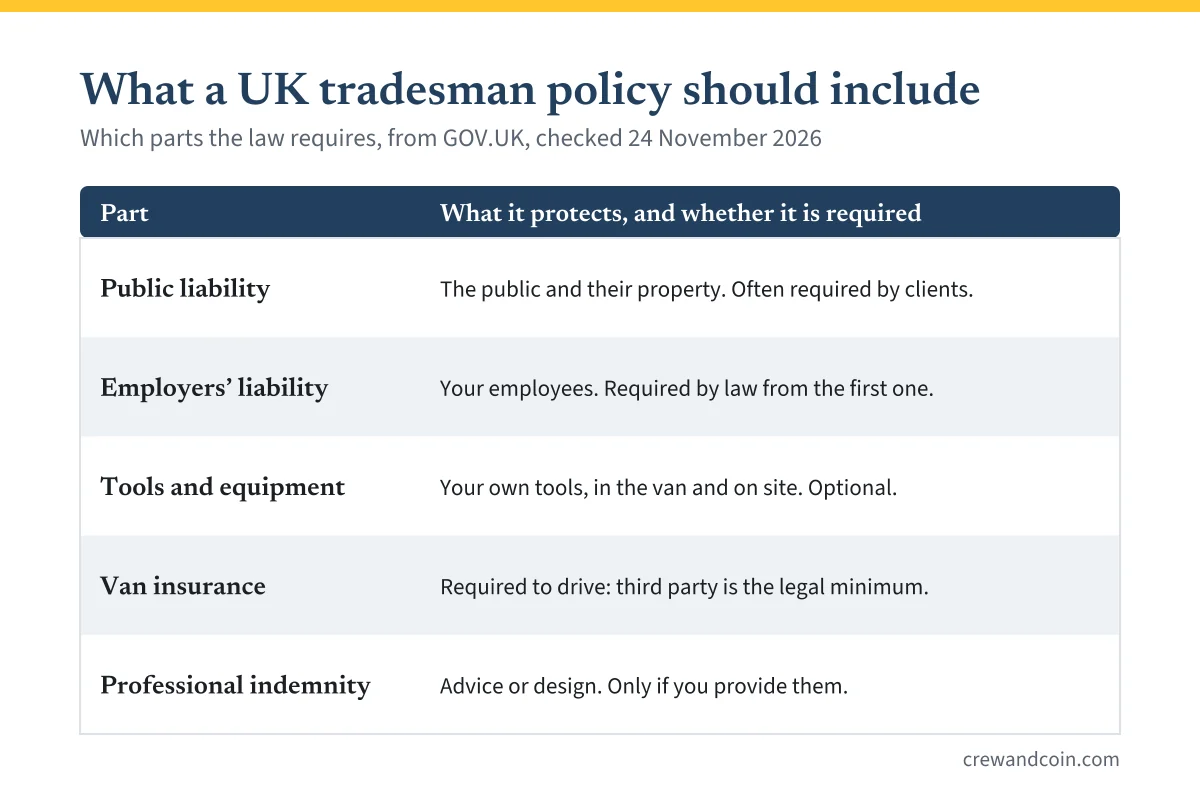
A tradesman policy usually combines public liability, employers' liability if you employ anyone (a legal requirement in Great Britain, at least £5 million), tools cover and van insurance (third party is the legal minimum), plus professional indemnity if you give advice or design.
This article is general information about business insurance, not insurance advice. Coverage, prices and legal requirements depend on your state or country, your trade and the insurer. Check the policy wording and your local regulator before you buy.
"Tradesman insurance" is not a single type of cover. It is the name insurers give to a package for builders, plumbers, electricians, decorators, gardeners and other trades, built from several policies that each protect against a different risk. Two packages with the same name and a similar price can protect you in very different ways, which is why it pays to know what should be inside before you compare quotes.
This guide explains what a tradesman insurance policy should include for a small UK trade business, which parts the law requires, which ones your clients will ask for, and what to check before you buy. It draws on GOV.UK, the Health and Safety Executive and the UK's financial protection schemes, checked on 24 November 2026. It is general information, not advice on a particular policy.
The parts of a tradesman policy
| Part | What it protects | Required? |
|---|---|---|
| Public liability | Injury to the public and damage to their property caused by your work | Not by law, but often by clients |
| Employers' liability | Injury or illness of your employees caused by their work | Yes, by law, from the first employee in Great Britain |
| Tools and equipment | Your own tools, in the van and on site | No |
| Van insurance | Your vehicle and other road users | Yes, at least third party, to drive on UK roads |
| Professional indemnity | Claims about advice or design you provide | Only if you give advice or design |
Public liability
Public liability is the core of most tradesman policies. It covers claims from customers, visitors and passers-by for injury or damage caused by your work, plus the cost of defending them. It is not compulsory in the way employers' liability is: the Financial Services Compensation Scheme protects 100% of claims under compulsory policies such as employers' liability, and puts public liability in its 90% group. But clients often require it, and GOV.UK reminds sole traders that they are personally responsible for all of the debts of the business.
The guide to public liability for sole traders covers what to check in detail, and cleaners have their own guide to public liability insurance for cleaners.
Employers' liability
If you employ anyone, this part is not optional. GOV.UK says you must get employers' liability insurance as soon as you become an employer, with cover of at least £5 million from an authorised insurer, and that you can be fined £2,500 for every day you are not properly insured. The guide to employers' liability insurance covers exemptions and who counts as an employee.
Tools and equipment
Neither liability cover pays for your own tools. Tools cover is usually an optional part of a tradesman package. Before you rely on it, ask:
- Does it cover theft from a locked van, and overnight?
- Does it cover tools left on site?
- Is there a limit per item, and does it pay to replace the tool or its used value?
Van insurance
GOV.UK says you must have motor insurance to drive your vehicle on UK roads, and that third party insurance is the legal minimum. It also notes that third party cover does not pay for repairs to your own vehicle. Tell your insurer that you use the van for work and carry tools, so the policy reflects how you really use it.
Professional indemnity
Most hands-on trades do not need professional indemnity, which covers claims arising from advice or design. If you design installations, specify materials for clients or give paid advice, ask whether you need it. The FSCS lists professional indemnity among the classes it protects at 100% when the insurer failed on or after 3 July 2015.
What to check before you buy
- Every trade you do is named. A policy for "plastering" may not respond to a claim from tiling. List all your work.
- The limits for public and employers' liability match the law and your clients' contracts.
- Heights and heat. Ask whether work at height or with heat, such as soldering or paint stripping, is excluded or limited.
- Subcontractors. Ask how the policy treats people who work with you but are not employees.
- Excess on each part, and whether you can pay it without strain.
- The insurer is authorised. GOV.UK tells employers to check the Financial Conduct Authority register; do the same for any business policy.
Health and safety comes first
Insurance pays after something goes wrong. The HSE says health and safety law applies to self-employed people whose work poses a risk to others and to those working in construction, and to anyone who employs others, even temporarily. Safe working practices, sound equipment and a short risk check before each job reduce both the chance of a claim and, over time, the cost of insurance.
If something goes wrong with the insurer
- If the insurer fails, the FSCS pays 90% or 100% of valid claims, depending on the type of cover. For general insurance claims, it says firms with an annual turnover above £1 million are generally not eligible, while for compulsory insurance usually all firms are eligible.
- If you have a complaint, the Financial Ombudsman Service can help small businesses and micro-enterprises. Complain to the insurer first; it usually has 8 weeks to respond, and you then have 6 months from its final response to go to the ombudsman.
Put the cost into your prices
A tradesman package is a fixed cost, like the van and the phone. Add it to your overhead and spread it across the hours you actually bill, as the complete pricing guide shows. Then check the price of each job carries it.
What to do next
List every type of work you do, whether you employ anyone and what your tools are worth. Ask your main clients what cover they require. Then get quotes for the same package from insurers you have checked on the FCA register, and read the exclusions before you choose.
Frequently asked questions
What does tradesman insurance cover?
It is a package. It usually includes public liability, and can add employers' liability, tools cover, van insurance and professional indemnity. Check which parts your quote actually includes.
Is tradesman insurance a legal requirement?
Parts of it can be. Employers' liability is compulsory once you employ people in Great Britain, and you must have at least third-party motor insurance to drive on UK roads. Public liability is not compulsory in the way employers' liability is, but clients often require it.
Does tradesman insurance cover my tools?
Only if the package includes tools cover. Liability insurance pays for harm to others, not for your own tools, so check the limits and whether theft from a van is covered.
More on insurance
Insurance · US
Handyman insurance: what you need and what it costs
Insurance · US
Painting contractor insurance: cover and what drives the price
Insurance · US