Insurance · US
Employers' liability insurance: when it is a legal requirement
Quick answer
In Great Britain you must have employers' liability insurance as soon as you become an employer, covering at least £5 million, from an authorised insurer. You can be fined £2,500 for every day without it, and £1,000 for not displaying the certificate. Employing only close family members is exempt.
This article is general information about business insurance, not insurance advice. Coverage, prices and legal requirements depend on your state or country, your trade and the insurer. Check the policy wording and your local regulator before you buy.
Picture a decorator who has worked alone for years and finally takes on a helper for a busy spring. The van is insured, the public liability policy is renewed, the helper starts on Monday. What is missing is the one business insurance policy that, in Great Britain, is a legal requirement from the day you become an employer: employers' liability.
This guide explains when employers' liability insurance is required, how much cover the law asks for, the fines for getting it wrong, who counts as an employee, and how to check your insurer. It is based on GOV.UK, the Health and Safety Executive and the UK's financial protection schemes, checked on 24 November 2026. It is general information, not advice on a particular policy.
What the law requires
GOV.UK sets out three requirements. You must get employers' liability (EL) insurance:
- as soon as you become an employer;
- to cover you for at least £5 million;
- from an authorised insurer.
GOV.UK explains that EL insurance helps you pay compensation if an employee is injured or becomes ill because of the work they do for you. The Health and Safety Executive describes it as compulsory insurance: by law, employers must insure against liability for injury or disease to their employees arising out of their employment.
The fines
| Failure | What GOV.UK says |
|---|---|
| Not being properly insured | A fine of £2,500 for every day you are not properly insured |
| Not displaying the certificate, or not showing it to inspectors | A fine of £1,000 |
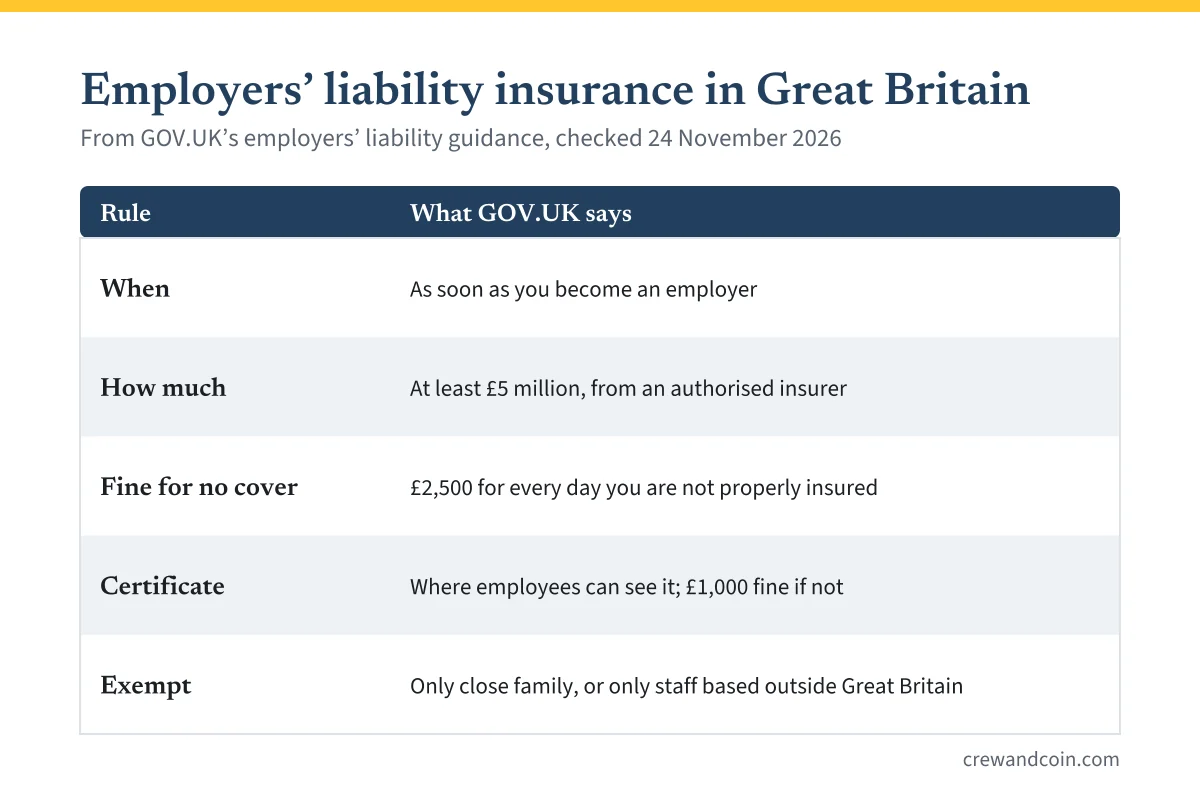
The daily fine is the reason not to leave this until the end of the first week. Arrange cover before the first employee's first day.
Displaying the certificate
GOV.UK says you must display your EL certificate where employees can access it, giving the workplace, your website or a work intranet as examples, and show it to inspectors when they ask. For a trade business with no fixed premises, a copy in the van, on the website or in a shared folder the team can open is the practical answer.
When you do not need it
GOV.UK lists two situations in which you do not need EL insurance, if you only employ:
- family members, which it lists as a husband, wife, civil partner, parent, grandparent, step-parent, child, grandchild, step-child, sibling or half-sibling; or
- someone who is based outside England, Scotland and Wales.
As soon as you employ someone outside those groups, the requirement applies.
Who counts as an employee
This is where many small trade businesses get caught. Calling a helper "self-employed" does not settle the question. GOV.UK says an employee is someone who works under an employment contract, and that someone who works for a business is probably an employee if most of a list of points are true, including:
- they cannot send someone else to do their work;
- a manager or supervisor is responsible for their workload;
- the business provides the materials, tools and equipment for their work.
A labourer who turns up when you say, works under your direction and uses your tools looks like an employee on that test. GOV.UK also notes that different rules apply to agency staff, freelancers, consultants and contractors, and that employment status for tax can differ from status in employment law. If you are unsure, ask your insurer how they treat the people who work with you, and get the answer in writing.
Health and safety comes with it
Employing someone also brings health and safety law into play. The HSE says that if you are self-employed but employ others, the law applies to you, even if you employ someone only temporarily, for example on a short-term contract. Insurance pays compensation; it does not replace the duty to manage risks in the first place.
Check the insurer
GOV.UK tells employers to check that the insurer is authorised by looking at the Financial Conduct Authority register. Do it before you pay, especially if you are buying through a website you do not know.
Two schemes protect you if something goes wrong later:
- If the insurer fails. The Financial Services Compensation Scheme says it pays 90% or 100% of the value of valid claims under a policy with a failed insurer, and lists employers' liability among the classes protected at 100%. The failed insurer must have been regulated by the Prudential Regulation Authority.
- If you have a complaint. The Financial Ombudsman Service says it can help small businesses and micro-enterprises. You complain to the insurer first; the insurer usually has 8 weeks to consider it, and you then have 6 months from its final response to take the complaint to the ombudsman.
Before your first employee starts
- Decide whether the person is an employee under the GOV.UK test.
- Buy EL cover of at least £5 million from an authorised insurer, checked on the FCA register.
- Make the certificate available to employees and keep a copy ready for inspectors.
- Review health and safety for the work they will do.
- Tell your public liability insurer that you now have staff, as it may change your cover.
- Add the cost to your hourly rate, as the complete pricing guide explains.
What to do next
If you are about to take on staff, get an EL quote now, alongside your other cover. The guide to tradesman insurance shows how employers' liability fits into a full policy for a trade business, and the guide to public liability insurance for sole traders covers the cover for injury and damage to the public.
Frequently asked questions
Is employers' liability insurance a legal requirement?
Yes, in England, Scotland and Wales, as soon as you become an employer. GOV.UK says it must cover at least £5 million and come from an authorised insurer.
What is the fine for not having employers' liability insurance?
GOV.UK says you can be fined £2,500 for every day you are not properly insured, and £1,000 if you do not display the certificate or show it to inspectors.
Do I need employers' liability insurance if I only employ family?
Not if you only employ close family members listed by GOV.UK, such as a spouse, civil partner, parent, child or sibling, or only people based outside England, Scotland and Wales.
More on insurance
Insurance · US
Contractor insurance: the complete guide for small businesses
Insurance · US
Cleaning business insurance: what cover you need
Insurance · US
Painting contractor insurance: cover and what drives the price
Sources
- GOV.UK: Employers' liability insurance
- HSE: Employers' Liability (Compulsory Insurance) Act 1969, a brief guide for employers
- GOV.UK: Employment status, employee
- HSE: Self-employed, does the law apply to me?
- FSCS: Insurance protection
- Financial Ombudsman Service: Time limits
- Financial Ombudsman Service: Who we can help