Insurance · UK
Public liability insurance for sole traders
Quick answer
Public liability covers claims from the public for injury or property damage caused by your work. It is not compulsory like employers' liability, but sole traders have unlimited liability, so a claim falls on their personal money, and many clients require proof of cover before work starts.
This article is general information about business insurance, not insurance advice. Coverage, prices and legal requirements depend on your state or country, your trade and the insurer. Check the policy wording and your local regulator before you buy.
Say you are a sole trader plasterer working in a customer's hallway. You lean a board against the wall, it slides, and it cracks the glass panel of their front door on the way down. Or a customer's child trips over your toolbag and needs stitches. Neither is your fault in any dramatic sense, but both can become a claim, and as a sole trader the claim lands on you personally.
This guide explains what public liability insurance does for a sole trader in the UK, why your personal money is at stake, what to check in a policy and what protections exist if something goes wrong with the insurer. It draws on GOV.UK, the Health and Safety Executive and the UK's financial protection schemes, checked on 24 November 2026. It is general information, not advice on a particular policy.
Why it matters more for a sole trader
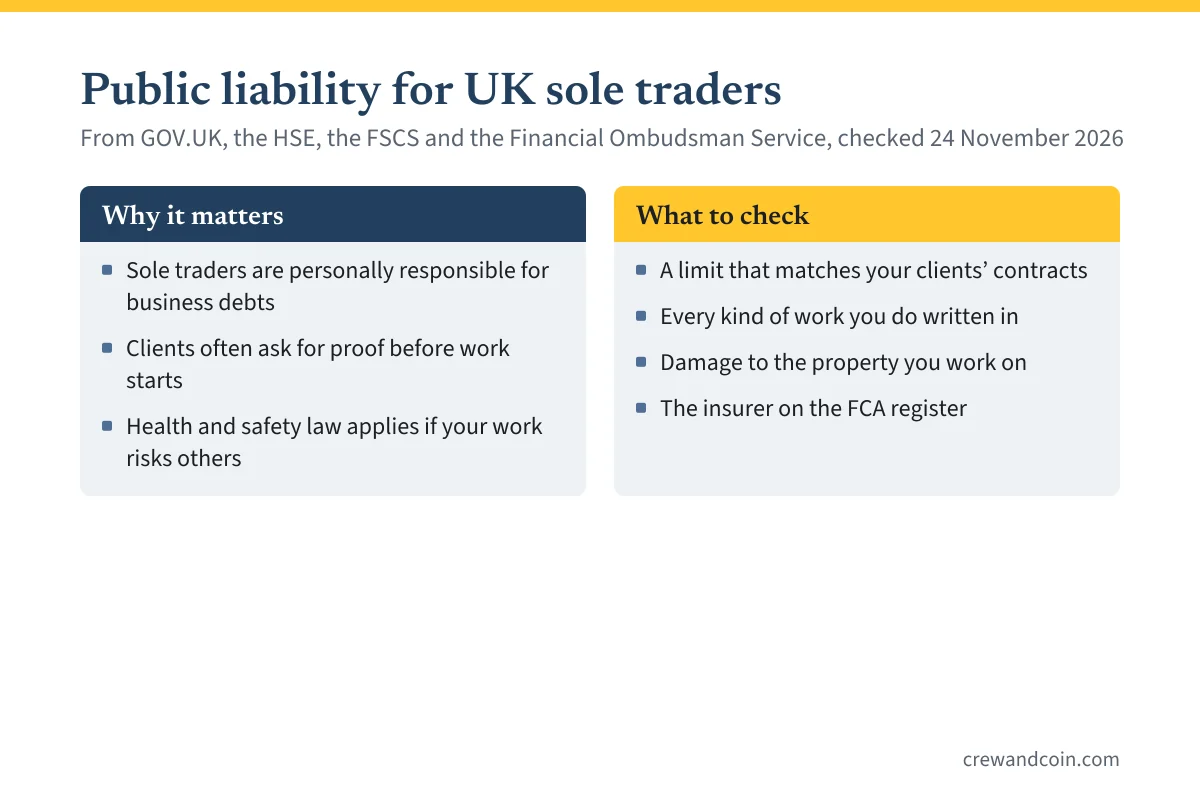
GOV.UK is direct about the risk of trading on your own. It says sole trader businesses have "unlimited liability", which means owners are personally responsible for all of the debts of the business. It adds that if something goes wrong you have less protection, and that you may be able to get more protection with business insurance.
In practice, that means a large compensation claim against your business is a claim against your savings, your car and, in the worst case, your home. Public liability insurance is what stands between a bad day on site and that outcome.
What public liability covers
Public liability insurance is designed for claims from members of the public, such as customers, visitors and passers-by, for:
- injury caused by your work, for example a trip over your tools;
- damage to their property, for example the cracked door panel;
- the legal costs of defending a claim.
It does not cover injury to your own employees. If you take someone on, employers' liability is a separate policy, and in Great Britain a legal requirement from the first employee, as the guide to employers' liability insurance explains.
Is it compulsory?
Not in the way employers' liability is. One way to see the difference is the Financial Services Compensation Scheme: it protects 100% of valid claims under compulsory policies such as employers' liability and third-party motor if an insurer fails, and puts public liability in the group protected at 90%.
In practice, though, you will often need it to get work. Main contractors, letting agents, councils, facilities managers and many householders ask to see proof of public liability before you start, and some set a minimum amount of cover in their contracts. Ask what they require before you buy, so the policy matches the work you want to win.
Health and safety still applies to you
Working alone does not take you outside health and safety law. The HSE says the law applies to a self-employed person whose work activity poses a potential risk to the health and safety of others, and to anyone doing certain high-risk activities, including work in construction. Most trade work in people's homes falls under that description. Insurance pays compensation; managing the risk is still your job.
What to check in a policy
- The limit of indemnity. The most the policy pays per claim. Match it to what your clients ask for.
- The description of your trade. List every kind of work you do. A policy that describes you as a "decorator" may not respond to a claim from work at height or from heat work, if you did not mention it.
- Work in customers' homes. Ask how the policy treats damage to the property you are working on, not just to other property nearby.
- Excess. How much you pay towards each claim.
- Tools and van. Public liability does not cover your own tools or your vehicle; those need separate cover, as the guide to tradesman insurance explains.
Check the insurer, and know your protections
GOV.UK advises employers to check that their insurer is authorised on the Financial Conduct Authority register, and the same check is sensible for any business policy. Do it before you pay, especially when buying online.
If something goes wrong later:
- If the insurer fails, the FSCS says it pays 90% or 100% of valid claims, with public liability in the 90% group. For general insurance claims, it says firms with an annual turnover of more than £1 million are generally not eligible. The failed insurer must have been regulated by the Prudential Regulation Authority.
- If you have a complaint, the Financial Ombudsman Service says it can help small businesses and micro-enterprises. Complain to the insurer first; it usually has 8 weeks to consider the complaint, and you then have 6 months from its final response to take it to the ombudsman.
Put the cost into your prices
Insurance is a fixed cost of trading. Spread it over the hours you actually bill, together with the van, phone and tools, as the complete pricing guide explains. A price that leaves it out means you are paying the premium out of your own wage.
What to do next
Ask your regular clients what cover they require, list every kind of work you do, and get quotes on the same terms from at least two insurers you have checked on the FCA register. If you plan to take on a helper, read the guide to employers' liability insurance before they start.
Frequently asked questions
Do sole traders need public liability insurance?
It is not compulsory like employers' liability, but GOV.UK says sole traders are personally responsible for all of the business's debts, and many clients ask for proof of public liability before work starts.
Does public liability cover my employees?
No. Injury to your own employees is covered by employers' liability insurance, which in Great Britain is a legal requirement from the first employee.
What happens if my insurer goes bust?
The FSCS says it pays 90% of valid public liability claims if an insurer fails, for eligible policyholders. Firms with turnover over £1 million are generally not eligible for general insurance claims.
More on insurance
Insurance · UK
Employers' liability insurance: when it is a legal requirement
Insurance · US
Handyman insurance: what you need and what it costs
Insurance · US