Insurance · UK
Public liability insurance for cleaners
Quick answer
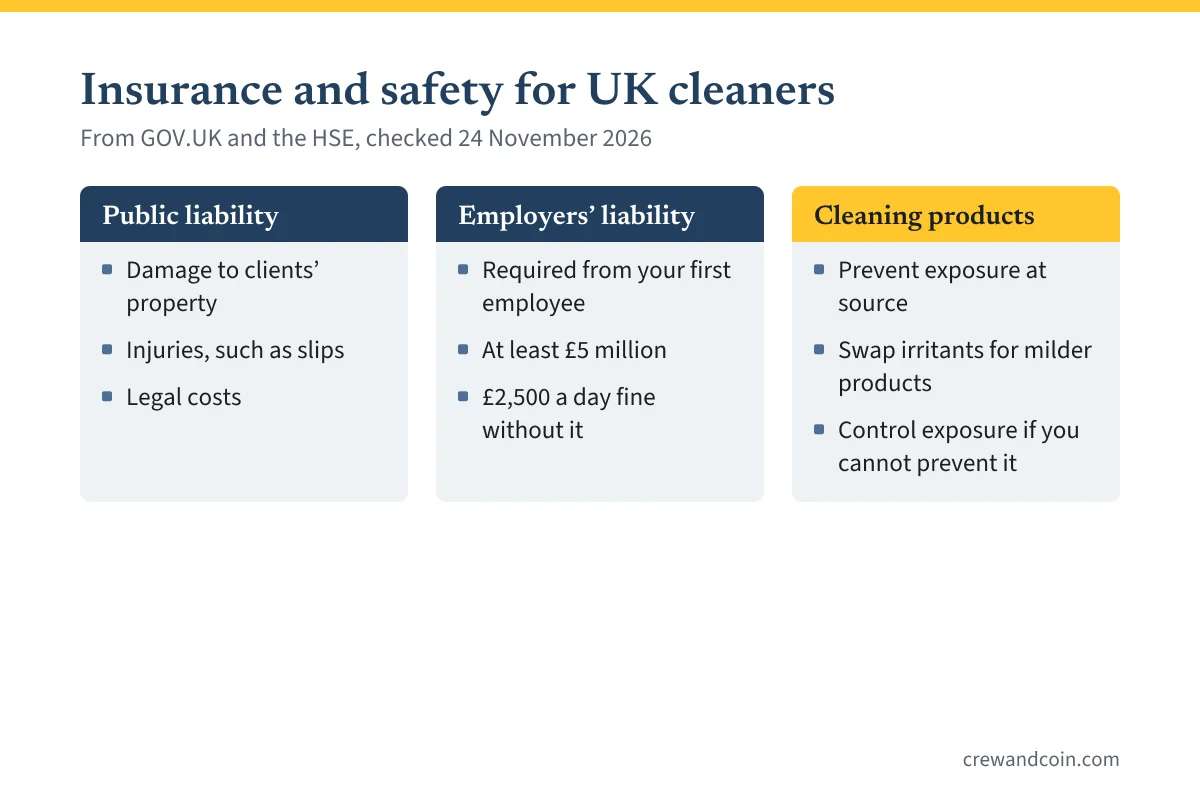
Public liability covers cleaners for damage to clients' property, injuries such as slips on wet floors, and legal costs. It is not compulsory like employers' liability, which you must have from your first employee (at least £5 million). Check cover for damage to items you clean and for lost keys.
This article is general information about business insurance, not insurance advice. Coverage, prices and legal requirements depend on your state or country, your trade and the insurer. Check the policy wording and your local regulator before you buy.
A cleaner works in other people's homes and offices every day, often alone and often with a key. Picture a bottle of bleach tipping onto a cream carpet, a vase knocked off a shelf while dusting, or a client slipping on a kitchen floor you mopped five minutes earlier. Each of those can become a claim, and each one is exactly what public liability insurance is for.
This guide explains public liability insurance for cleaners and small cleaning businesses in the UK: what it covers, when employers' liability is needed as well, what health and safety law expects when cleaning products are involved, what to check in a policy and where to turn if something goes wrong. It draws on GOV.UK, the Health and Safety Executive and the UK's financial protection schemes, checked on 24 November 2026. It is general information, not advice on a particular policy.
What public liability covers for a cleaner
Public liability covers claims from clients and other members of the public for:
- damage to their property caused by your work, such as a stained carpet or a broken ornament;
- injury caused by your work, such as a slip on a wet floor;
- the legal costs of defending a claim.
It does not cover your own equipment or injury to anyone you employ.
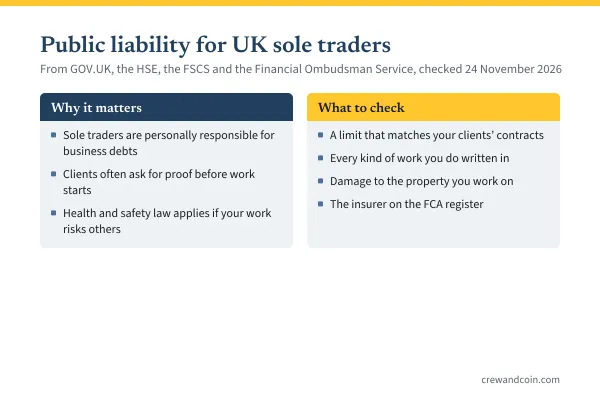
If you work as a sole trader, it matters more than it might seem. GOV.UK says sole traders have unlimited liability, which means they are personally responsible for all of the debts of the business. A claim you cannot pay becomes a debt you carry personally.
Is it compulsory?
Not in the way employers' liability is. The Financial Services Compensation Scheme protects 100% of claims under compulsory policies, such as employers' liability, if an insurer fails, and puts public liability in its 90% group. In practice, though, many commercial clients, letting agents and offices ask to see proof of public liability before you start, and it is often what reassures a household letting a stranger in with a key.
When you also need employers' liability
Cleaning businesses grow by taking on cleaners, and that brings a legal requirement. GOV.UK says you must have employers' liability insurance as soon as you become an employer, with cover of at least £5 million from an authorised insurer, and that you can be fined £2,500 for every day you are not properly insured.
Whether your cleaners are employees is not a matter of what you call them. GOV.UK's test says someone is probably an employee if most of a list of points are true, including that they cannot send someone else to do the work, someone else manages their workload, and the business provides the materials and equipment. A cleaner who works the rota you set, with your products, to your checklist, usually fits that description. The guide to employers' liability insurance covers the rules and exemptions.
Cleaning products and COSHH
Cleaning products are where cleaning businesses meet health and safety law most directly. The HSE's guidance on hazardous substances, known as COSHH, asks employers to:
- prevent exposure at source where possible, for example by swapping an irritant cleaning product for something milder;
- control exposure adequately where it cannot be prevented, so the risk of harm is as low as is reasonably practicable;
- keep exposure below the workplace exposure limit where one exists.
For a self-employed cleaner with no staff, the HSE says health and safety law applies if your work poses a potential risk to the health and safety of others. Cleaning in clients' homes, with products that can harm people and pets, is a good reason to treat it as applying to you. A short product list, clear labels and never mixing products are the basics, as the guide to starting a cleaning business explains.
What to check in a policy
- The limit of indemnity, matched to what your commercial clients and agencies ask for.
- Damage to the property you are cleaning. Ask how the policy treats damage to the items and surfaces you are working on, not just to other property nearby.
- Keys. If you hold clients' keys, ask whether lost keys and the cost of changing locks are covered.
- Products and equipment. Ask whether damage caused by cleaning products, such as a stained surface, is included.
- Your own equipment. Vacuums and machines need separate cover; public liability does not pay for them.
- The insurer is authorised. GOV.UK advises checking the Financial Conduct Authority register for employers' liability insurers, and the same check is worth doing for any policy.
If something goes wrong with the insurer
- If the insurer fails, the FSCS says it pays 90% or 100% of valid claims, with public liability in the 90% group and employers' liability at 100%. For general insurance claims, it says firms with an annual turnover above £1 million are generally not eligible.
- If you have a complaint, the Financial Ombudsman Service says it can help small businesses and micro-enterprises. Complain to the insurer first; it usually has 8 weeks to consider the complaint, and you then have 6 months from its final response to take it to the ombudsman.
Put the cost into your prices
Insurance is one of the fixed costs that a cleaning price has to carry, along with products, travel and your own time. The guide to pricing house cleaning jobs shows how to build it into a price per visit.
What to do next
Ask your regular and commercial clients what cover they expect, decide whether your cleaners are employees under the GOV.UK test, and get quotes on the same terms from insurers you have checked on the FCA register. If you also want to protect your equipment and van, the guide to tradesman insurance shows what a fuller package includes.
Frequently asked questions
Do cleaners need public liability insurance?
It is not compulsory in the way employers' liability is, but self-employed cleaners are personally responsible for business debts, and many clients ask for proof of public liability before work starts.
Do I need employers' liability if I employ cleaners?
Yes, in Great Britain, as soon as you become an employer. GOV.UK says cover must be at least £5 million from an authorised insurer, with fines of £2,500 for every day without it.
What does COSHH mean for a cleaning business?
The HSE's COSHH guidance asks employers to prevent exposure to hazardous substances at source, for example by using milder products, and to control exposure adequately where it cannot be prevented.
More on insurance
Insurance · US
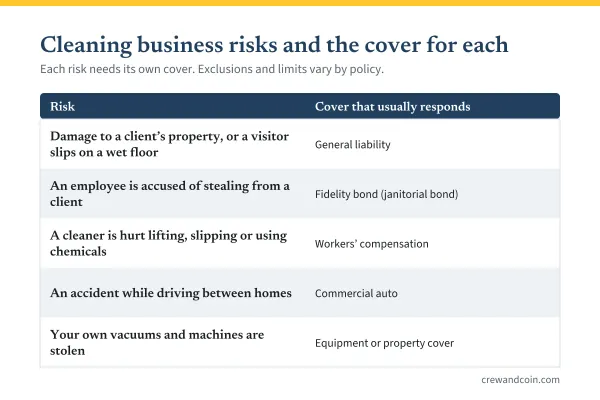
Cleaning business insurance: what cover you need
Insurance · US
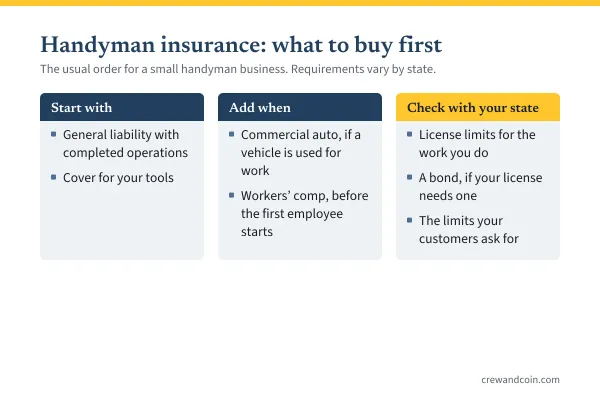
Handyman insurance: what you need and what it costs
Sources
- GOV.UK: Set up as a sole trader
- GOV.UK: Employers' liability insurance
- GOV.UK: Employment status, employee
- HSE: COSHH basics, what you need to do
- HSE: Self-employed, does the law apply to me?
- FSCS: Insurance protection
- FSCS: Small business claims
- Financial Ombudsman Service: Time limits
- Financial Ombudsman Service: Who we can help