Starting
How to start a pool cleaning business
Quick answer
Find out which tasks your state lets you do without a contractor license, learn the CDC water targets, follow strict chemical safety rules, buy a basic route kit, get liability insurance that covers chemicals, price each stop from your costs and build a tight route.
A pool service route is one of the steadier businesses in the home service trades. The same customers, the same day every week, paid monthly. There is no selling a new job each morning. What makes or breaks it is less visible: how close the pools are to each other, whether you are allowed to do the repairs customers will ask for, and how you handle chemicals that send thousands of people to the emergency room every year.
This guide covers what to decide before the first pool, in order. For registration, business structure and taxes, which are the same in every trade, keep the guide to starting a home service business open as well.
Step 1: separate cleaning from repair
Customers will not see a difference between cleaning a pool and fixing its pump. The law in your state probably does.
| Work | Examples | What to ask your state |
|---|---|---|
| Routine maintenance | Skimming, brushing, vacuuming, emptying baskets, testing and balancing water | Whether any license or registration is needed |
| Equipment repair and replacement | Motors, pumps, filters, heaters, lights | Which contractor license covers it |
| Construction and remodeling | Building, resurfacing, structural work | Contractor work, outside a maintenance business |
Two examples show how differently states draw the line:
- California. The Contractors State License Board has a pool and spa maintenance classification, C-61/D-35, for contractors who install, replace or repair pool motors, pumps, filters, gas heaters and related equipment. California requires a contractor license for work valued at $1,000 or more in combined labor and materials.
- Florida. State law says a license is not required for cleaning a pool or spa in a way that does not affect the structural integrity of the pool or its associated equipment, and that water treatment that does not require permanently attached equipment does not require a license. Installing, modifying, substantially disassembling or replacing that equipment does.
Those are two states. Yours will have its own rule, so check your county and city as well. Call the state contractor board before you print a service list, and ask one direct question: "Which of these tasks can I do without a contractor license?"
If you want commercial accounts such as apartment complexes, hotels or gyms, also ask your state or local health department what applies to public pools before you bid.
Step 2: learn the water before you sell the service
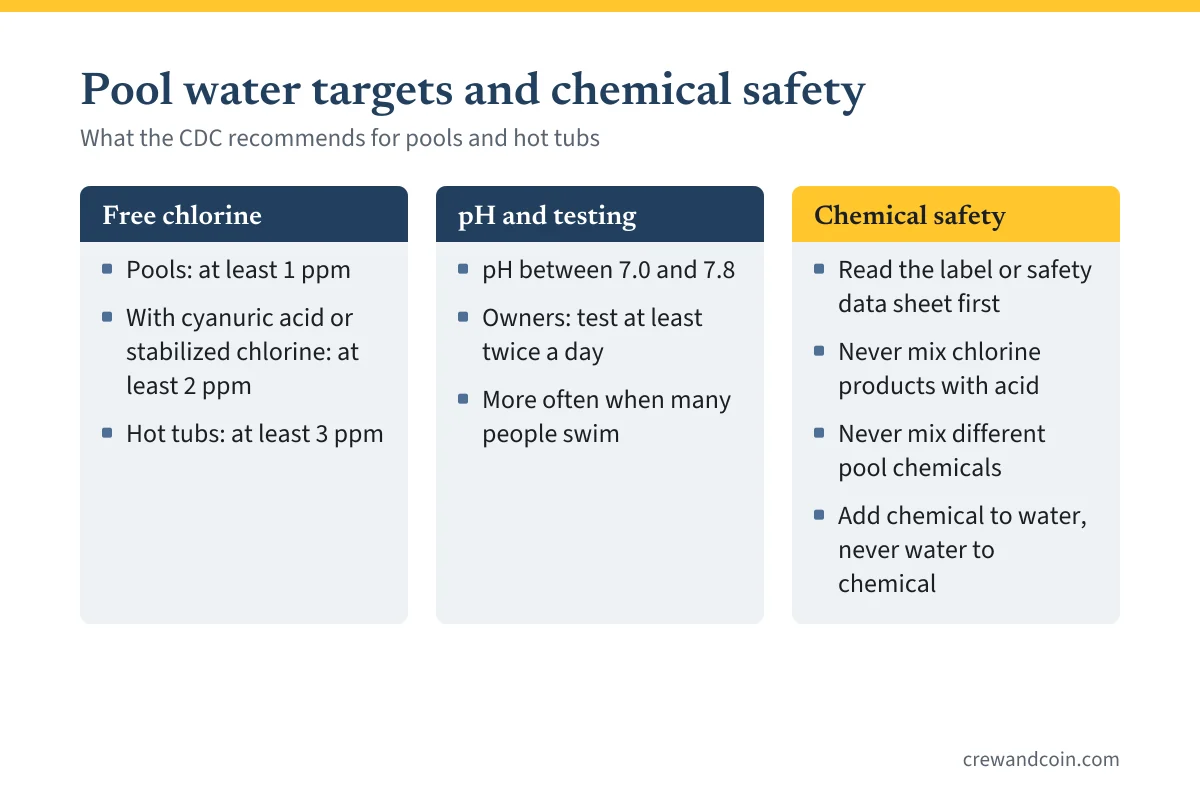
Your product is water that is safe to swim in. The CDC publishes the targets a pool should meet:
| Measure | CDC guidance |
|---|---|
| Free chlorine, pools | At least 1 ppm |
| Free chlorine, pools using cyanuric acid or stabilized chlorine | At least 2 ppm |
| Free chlorine, hot tubs | At least 3 ppm |
| pH | 7.0 to 7.8 |
The CDC also tells pool owners to test the water at least twice a day, and more often when many people are swimming. A weekly visit cannot do that for them. Say so plainly when you sign a customer: you balance the water every week, and they keep an eye on it in between, especially after heavy use or storms. It is honest, and it protects you when a pool turns green on day five.
Buy a good test kit, test at every visit, and write the readings down. A log of what you found and what you added is your best answer to any complaint.
Step 3: take chemical safety seriously
Pool chemicals are the real hazard of this trade. The CDC estimates that pool chemical injuries lead to about 4,500 emergency department visits in the United States each year. In its study of 2015 to 2017, the most common diagnosis was poisoning, mostly from breathing in fumes, and more than half of the injuries happened at a home.
The CDC's rules for handling them are short. I'd put them on a card in the truck:
- Read the entire product label or safety data sheet before using a product.
- Wear the safety equipment the label calls for.
- Handle chemicals in a well-ventilated area.
- Open one container at a time, and close it before opening another.
- Never mix chlorine products with acid; this can create toxic gases.
- Never mix different pool chemicals with each other.
- Pre-dissolve only when the label says to, and add the chemical to water, never water to the chemical.
Your vehicle is a chemical store on wheels. Keep chlorine and acid apart, upright, closed and secured, follow each label's storage instructions, and never leave containers in a closed cab.
Once you have employees, OSHA's Hazard Communication Standard applies: labels and safety data sheets for the products they use, and training on how to handle them.
Step 4: buy the route kit
| Item | Why |
|---|---|
| Telescopic pole, skimmer net, wall and tile brushes | Every visit |
| Vacuum head, hose, and leaf canister | Debris on the floor |
| Test kit with fresh reagents | Readings you can trust |
| Chemicals for a week of stops, in sealed containers | Balancing on site |
| Gloves and eye protection | Handling chemicals |
| Secured, ventilated storage in the vehicle | Transport |
| Route and logging software, or a paper log | Readings, chemicals added, photos |
Start with what one route needs. Automatic cleaners, repair tools and spare parts can wait until you know which repairs you are allowed to do and which ones your customers actually ask for.
Step 5: insurance
General liability is the starting point, as in any trade that works on customers' property. Tell the insurer you handle and transport pool chemicals, and ask whether damage to pool surfaces and equipment from chemical treatment is covered, because not every policy treats it the same way. For the vehicle, ask whether your current auto policy covers business use or whether you need commercial auto.
With employees, the SBA lists workers' compensation, unemployment and disability insurance as required for businesses, and state laws vary.
Step 6: price the stop, then the month
Pool service is sold by the month and earned by the stop. Build the price from one visit, using the method in the complete pricing guide.
Take an example with a labor cost of $28 an hour and overhead of $11.54 per working hour, so $39.54 an hour. A typical stop takes 30 minutes on site and 10 minutes of driving:
| Line | How it is worked out | Amount |
|---|---|---|
| Time | 40 minutes × $39.54 an hour | $26.36 |
| Chemicals | Average per visit | $10.00 |
| Cost per visit | $36.36 | |
| Price per visit at 20% margin | $36.36 ÷ 0.80 | $45.45 |
| Monthly price | $45.45 × 52 visits ÷ 12 months | $196.95 |
That is about $197 a month for this pool. These are example figures; your wage, your overhead and your chemical costs will be different.
Now change one number. If the drive between stops is 25 minutes instead of 10, the visit takes 55 minutes, the cost rises to $46.25 and the monthly price has to be about $251 to keep the same margin. The pool did not change. The route did. That is why two pools on the same street are worth more to you than two pools across town, and why a tight service area is the most important pricing decision in this business.
Decide in writing how chemicals are billed. Some businesses include a standard amount and charge extra for large corrections, such as clearing a green pool. Others bill all chemicals separately. Either works if the customer knows before the first invoice.
Step 7: build the route street by street
- Pick a small area and stay in it. Turn down pools that are far away, or price the drive in.
- Ask every customer about the neighbors. A referral next door costs you almost no extra time.
- Offer one clear plan. Weekly service, what is included, what is extra, and the monthly price.
- Leave a note after every visit, with the readings and what you did. It is the cheapest marketing you have.
- Quote repairs and one-off cleanups separately, with a written scope, as described in the guide to writing a job estimate.
What to do next
Call your state contractor board about the line between maintenance and repair, get insurance quotes that mention chemicals, and time a practice stop from parking to leaving. Then run the visit through the job price calculator and set a monthly price before you sign the first customer.
Frequently asked questions
Do I need a license to clean pools?
It depends on the state. Florida law, for example, does not require a license for cleaning that does not affect the structural integrity of the pool or its equipment, while repairing or replacing equipment does. Ask your state contractor board.
What chlorine and pH levels should a pool have?
The CDC recommends free chlorine of at least 1 ppm in pools, at least 2 ppm when cyanuric acid or stabilized chlorine is used, at least 3 ppm in hot tubs, and a pH of 7.0 to 7.8.
How do pool service businesses charge?
Usually a monthly price for weekly visits. Build it from the cost of one stop, including driving time and chemicals, add your margin and multiply by 52 visits divided by 12 months.
More on starting
Sources
- CSLB: D-35 Pool and spa maintenance contractor
- Florida Statutes: section 489.105, definitions
- CDC: Home pool and hot tub water treatment and testing
- CDC: Guidelines for keeping your pool safe and healthy
- CDC MMWR: Pool chemical injuries in public and residential settings, 2008-2017
- OSHA: Hazard Communication
- SBA: Get business insurance