Starting
How to start a cleaning business with no money
Quick answer
You cannot start for exactly $0, but you can start for very little. Get a free EIN, pay only for registration, any local license and insurance, clean with your customers' supplies at first, and buy equipment with the money from your first jobs.
On this page
Search for how to start a cleaning business with no money and you will find plenty of pages promising it can be done for $0. It cannot, quite. A registration fee, a license where your city asks for one and a first insurance payment all cost something. But cleaning is one of the few trades where "almost nothing" is realistic: no van full of machines, no stock, and customers who pay on the day.
This guide is the low-budget route: what is free, what you have to pay for, what can wait, and how to make the first few jobs pay for everything else. For the full list of setup steps, keep the guide to starting a home service business open alongside it.
What "no money" really means
Split every cost into three piles before you spend anything.
| Pile | What goes in it | Examples |
|---|---|---|
| Free | Things that cost time, not money | EIN, a price sheet, a simple service list, asking people you know, free business mentoring |
| Cannot skip | Legal and safety basics | Registration and local license where required, insurance, basic gloves |
| Can wait | Anything a customer does not need on the first clean | Logo, uniforms, website, a commercial vacuum, software, vehicle lettering |
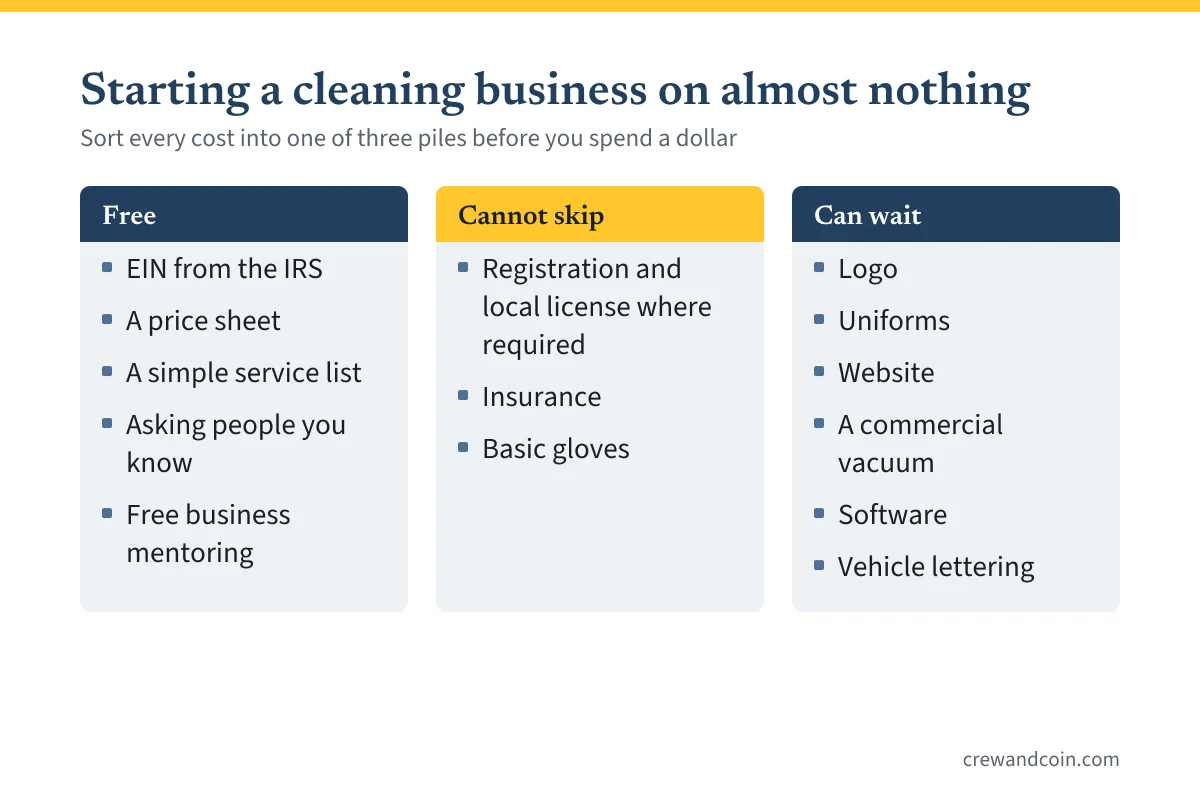
Most new owners spend their first dollars on the third pile because it feels like building a business. I'd do the opposite: spend only on the second pile until customers are paying.
What is free
An EIN. The IRS issues Employer Identification Numbers for free, online. It warns that you never have to pay a fee for one, so if a website asks for money, you are on the wrong website.
Advice. The SBA funds a network of resource partners. SCORE mentors offer advice at no cost on topics like financing, human resources and business planning, and Women's Business Centers provide free to low-cost counseling and training. An hour with a mentor before you set prices is worth more than a logo.
Your first marketing. Telling neighbors, friends, former coworkers and local community groups costs nothing. Neither does claiming your business listing on Google Maps and asking every happy customer for a review.
Your prices. Working out what to charge takes a pencil and an hour. Do it before the first clean, not after, with the house cleaning pricing guide.
What you cannot skip
Registration and licenses. The SBA explains that the licenses and permits you need depend on your business activity and your location, and that fees vary. Call your city and county and ask two questions: do I need a general business license to clean homes, and do I need to register a trade name? Write down the fees. That is your first real number.
Insurance. You will be working alone inside other people's homes, around floors, screens and stone counters that cost more to replace than you will earn in a month. General liability insurance is what stands between one accident and the end of the business. The rules change once you have employees: the SBA lists workers' compensation, unemployment and disability insurance as required for businesses with employees, and state laws vary. Ask for a monthly payment plan rather than paying a year up front.
Basic protection. Gloves, and reading the label on every product you use.
Start with the customer's supplies
Here is the move that makes a near-zero start possible: for your first customers, clean with their products and their vacuum.
Plenty of households prefer it. They already own products they trust on their surfaces, and nothing from another home comes into theirs. Say it as a choice, not as an apology:
"I can bring my own supplies, or use yours if you have products you prefer. Which would you like?"
That leaves you buying only what makes you faster and what customers rarely have enough of:
| First kit | Why |
|---|---|
| Microfiber cloths, color-coded | Kitchens and bathrooms never share a cloth |
| Scrub brushes and a detail brush | Grout, taps, edges |
| Spray bottles, labeled | Decant the customer's products safely, one product per bottle |
| Gloves | Every clean |
| A caddy or bucket | Carry everything in one trip |
Price that kit at your local store before you buy. It is a small fraction of a full equipment list, and the startup cost worksheets show the complete picture once you are ready to plan a full year.
Let the first jobs buy the equipment
With no savings to spend, the order you buy things in matters more than the total. A simple ladder, with example numbers:
| Stage | Money coming in (example) | What it pays for |
|---|---|---|
| Cleans 1 to 3 | $450 | Insurance payment, license fee, first kit |
| Cleans 4 to 8 | $750 | Your own vacuum and a standard product set |
| Cleans 9 to 15 | $1,050 | Mop system, spare cloths, printed cards |
| First month with recurring customers | Steady | Scheduling software, a simple website |
The figures assume $150 per clean and are only there to show the order. The rule behind the ladder is that every purchase should either be required or make you faster, and each one is paid for by work already done.
Find the first customers for free
You are looking for recurring customers, weekly or biweekly, close to each other. Four of them cover more of your costs than fifteen one-off cleans.
- Write a list of fifty people you know and tell each one directly what you are offering and where.
- Offer your first three customers a fair price in exchange for an honest review, not a deep discount. Low prices attract customers who leave when you raise them.
- Ask every customer for one referral on the day they say they are happy.
- Stay in a small area. Every extra mile is fuel you pay for today.
A mistake a lot of new owners make is setting prices low because they need the work. Being short of money is the reason to price properly, not the reason to give hours away. A price built from your real costs is how the business starts paying you.
Set money aside from the first payment
A cleaning business with no savings has no cushion for a tax bill either. As a self-employed person you pay both halves of Social Security and Medicare. The IRS sets the self-employment tax rate at 15.3 percent, made up of 12.4 percent for Social Security and 2.9 percent for Medicare, and you have to file Schedule SE once your net earnings from self-employment are $400 or more. Income tax comes on top.
So open a separate account, even a free one, and move a fixed share of every payment into it the same day. Ask a tax professional what share fits your situation; the point is to start with the very first clean.
If you really need to borrow
Borrowing is not the first step, but it helps to know what exists.
The SBA's microloan program offers loans of up to $50,000 through nonprofit, community-based intermediary lenders. According to the SBA, the average microloan is about $13,000, interest rates are generally between 8 and 13 percent and the maximum repayment term is seven years. The money can go to working capital, supplies and equipment, but not to paying existing debts or buying real estate. The SBA-approved lenders make all credit decisions and set the terms of each microloan.
On using your own savings, the SBA is direct: with self-funding you keep complete control of the business, but you also take on all the risk yourself. It warns against spending more than you can afford and against tapping retirement accounts early, which can mean expensive fees or penalties.
For a solo cleaning start, I'd treat a loan as a way to grow something that already has customers, not as a way to begin.
Mistakes that turn "no money" into "lost money"
- Buying equipment before the first customer.
- Skipping insurance to save one month's payment.
- Pricing below cost to win work.
- Taking jobs far apart and burning the profit in fuel.
- Spending the tax money.
- Paying a website to file a free EIN.
What to do next
Call your city and county about licenses, get three insurance quotes with monthly payments, and write your price sheet. Then follow the ten steps in the guide to starting a cleaning business, and check your first prices with the job price calculator before you quote anyone.
Frequently asked questions
Can you really start a cleaning business with no money?
Not with exactly zero. Registration, any local license and insurance cost something. But you can keep the start very cheap by using customers' supplies at first and buying equipment from your first payments.
Do I need insurance before my first cleaning job?
Insurance rules vary by state, and the SBA lists the cover required once you have employees. Working uninsured in someone's home means one accident could cost more than the business earns, so get general liability quotes before you start.
Is there a loan for starting a small cleaning business?
The SBA microloan program offers loans of up to $50,000 through nonprofit intermediary lenders, with an average of about $13,000. The lenders make the credit decisions and set the terms.