Starting
How to start a gutter cleaning business
Quick answer
Start with cleaning and downspout flushing, buy a rated fiberglass ladder with a stabilizer, follow OSHA's ladder rules, check state and local licenses, get general liability insurance, price each house from your own timings and sell spring and fall plans.
Gutter cleaning has one of the shortest lists of things to buy in the home service trades: a ladder, gloves, a scoop, a blower and a way to haul debris. That is why so many people start it, and also why so many quit after one season. The work is seasonal, the price is easy to underestimate, and almost all of the risk comes from one piece of equipment.
This guide covers the setup in the order that matters: what to offer, how to work on a ladder without getting hurt, what to check on licenses and insurance, how to price a house, and how to smooth out a business that peaks twice a year. For the general steps every trade shares, such as registration and taxes, use the guide to starting a home service business alongside this one.
Step 1: decide what you will offer
Keep the first season simple. A clear service list is easier to price and easier to sell.
| Service | What it involves | Check first |
|---|---|---|
| Gutter cleaning | Removing debris by hand or blower, bagging it, rinsing | Disposal of the debris |
| Downspout flushing | Clearing blockages and testing flow with a hose | Access to water on site |
| Minor repairs | Re-fixing loose hangers, sealing small leaks | Whether your state treats it as contractor work |
| Gutter guard installation | Fitting covers or screens to existing gutters | Whether your state requires a contractor license |
Cleaning and flushing are maintenance. Repairs and installations can cross into licensed contractor work, depending on the state and the value of the job, so check before you add them to the list.
Step 2: treat the ladder as the whole safety plan
Nearly everything that can go badly wrong in this trade happens on or around a ladder. If you work alone, nobody enforces the rules for you. If you hire, OSHA's ladder standard applies to you as an employer, and it is a good checklist either way. Among other things, it requires that:
- ladders are used only on stable and level surfaces, unless they are secured or stabilized
- no ladder is moved, shifted or extended while someone is on it
- each employee faces the ladder when climbing up or down
- each employee uses at least one hand to grasp the ladder when climbing
- ladders are not loaded beyond the maximum intended load, which includes the worker plus tools, equipment and materials
- the top step and cap of a stepladder are not used as steps
- when a ladder is used to reach an upper landing, the side rails extend at least 3 feet above it
For the setup angle, OSHA's construction ladder standard gives the figure most people know as the four-to-one rule: the horizontal distance from the top support to the foot of the ladder should be about one-quarter of the ladder's working length. With 16 feet of ladder between the ground and the gutter line, the base sits about 4 feet out from the wall.
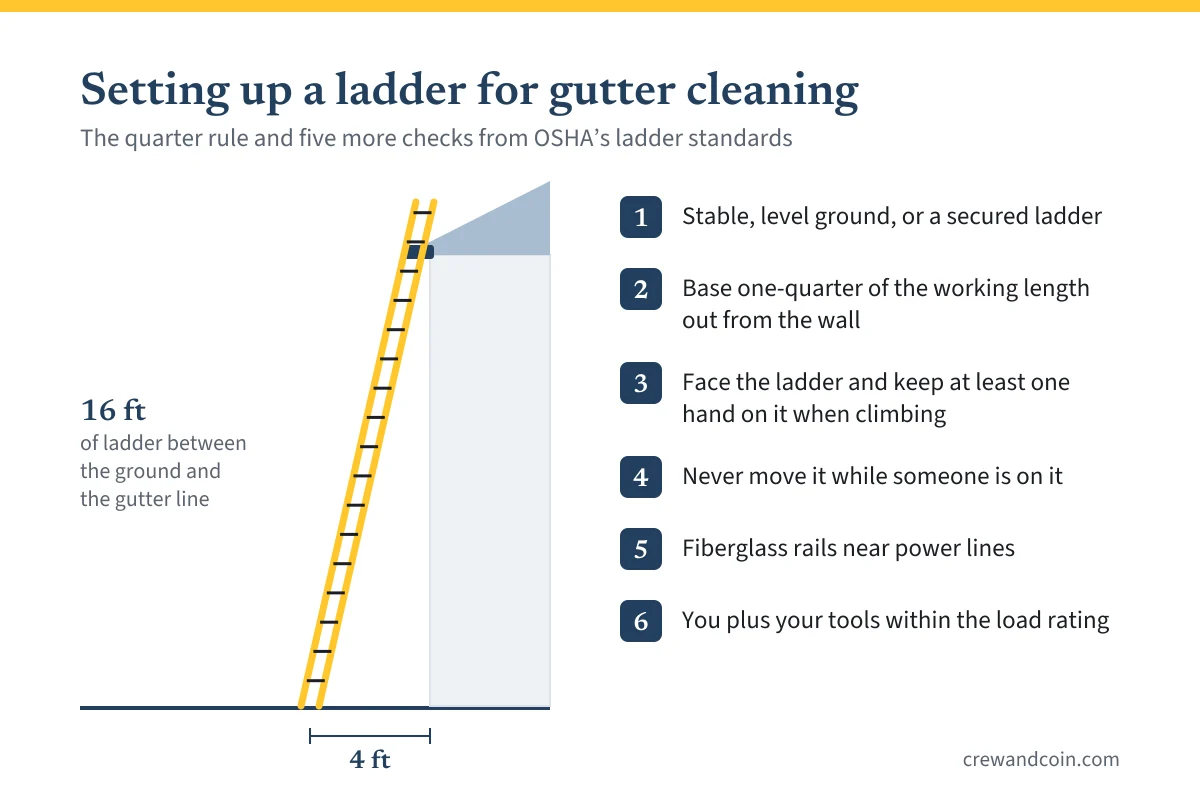
Two more points from the same rules matter for gutter work:
- Power lines. The service line to the house often runs close to the roof edge. OSHA requires ladders with nonconductive side rails where the worker or the ladder could contact energized electrical equipment. A fiberglass ladder is the usual choice for that reason.
- Getting on the roof. OSHA's general industry rules require fall protection for employees on a surface with an unprotected side or edge 4 feet or more above a lower level. If your method involves walking the roof, that changes the equipment you need and the price of the job. Many small operators decide to work only from the ladder or from the ground.
A mistake a lot of new owners make is stretching sideways to reach the last two feet instead of climbing down and moving the ladder. Price the job so that moving the ladder twenty times is paid for, and nobody is tempted to skip it.
Step 3: buy a short, solid kit
| Item | Why |
|---|---|
| Fiberglass extension ladder, rated for you plus your tools | Reach and electrical safety |
| Ladder stabilizer or standoff | Keeps the ladder off the gutter and steadier at the top |
| Leg levelers or a leveling base | Stable footing on slopes |
| Gloves and eye protection | Sharp edges, debris, whatever lives in the gutter |
| Scoop, buckets or bags | Debris goes down with you, not onto the lawn |
| Blower and a hose with a nozzle | Final clean and downspout test |
| Tarps | Protect beds and paths, speed up cleanup |
Ground-based vacuum and pole systems let you clean some single-story gutters without climbing. They cost more up front and are slower on heavy, wet debris, but they remove the main risk. If you plan to hire, they are worth pricing.
Step 4: licenses and insurance
The SBA explains that the licenses and permits a business needs depend on its activity and location, with requirements at the state, county and city level. For gutter cleaning, ask your city and county about a general business license, and ask your state contractor board whether cleaning, repairs and guard installation are treated differently.
On insurance, general liability is the policy customers will ask about, and it matters when a ladder dents a gutter or debris stains a patio. Tell the insurer exactly what you do, including working at height, because a policy that does not match the work may not respond when you need it. Once you have employees, the SBA lists workers' compensation, unemployment and disability insurance as required, and state rules vary.
Step 5: price the house, not the foot
Customers like a price per linear foot. It only works if it comes from your own time and costs, as explained in the complete pricing guide. What changes the time is not just the length of gutter:
- number of stories
- roof pitch and how the ground slopes
- how full the gutters are, and with what
- how many times the ladder has to move
- access: fences, beds, decks, locked gates
Here is a worked example for a single-story house with 160 linear feet of gutter, using an example cost of $51.43 per working hour (labor plus overhead):
| Line | How it is worked out | Amount |
|---|---|---|
| Time | 1.5 h on site + 0.5 h drive and setup | 2 h |
| Hourly cost | 2 h × $51.43 | $102.86 |
| Bags and disposal | $5.00 | |
| Total cost | $107.86 | |
| Price at 20% margin | $107.86 ÷ 0.80 | $134.83 |
Round it to $135, which works out to about $0.84 per linear foot for this house. A two-story house with the same length of gutter takes longer on every ladder move, so it needs its own, higher rate. Time your first ten jobs and you will have real rates for both.
Small houses are where this trade loses money. Set a minimum job charge so a 60-foot job still pays for the trip.
Step 6: plan for two peaks and two quiet spells
Demand follows the trees: a large peak when the leaves come down in fall and a smaller one in spring. Three things make the year more even:
- Sell a plan, not a visit. Offer a spring and fall service booked in advance at a fixed annual price. It fills the calendar before the season starts.
- Add a second service with a different season. Pressure washing fits the same customers and peaks in the warmer months; the guide to starting a pressure washing business covers what it takes.
- Use the quiet months. Maintain equipment, renew plans and contact last year's customers before the next peak.
Step 7: find the first customers
- Start on streets with mature trees and single-story houses.
- Leave a simple card with a before-and-after offer: a photo of the gutter before and after, sent with the invoice.
- Ask every customer whether the neighbors need the same. Two houses on one street cost you one trip.
- Offer the annual plan at the end of the first job, while the clean gutter is fresh in their mind.
What to do next
Check your local license rules, get insurance quotes that mention work at height, and time your first jobs from door to door. Then build your per-foot rates from those timings with the job price calculator.
Frequently asked questions
Do I need a license to clean gutters?
It depends on your state, county and city. Cleaning is usually treated as maintenance, but repairs and gutter guard installation can count as contractor work in some states. Ask your city, county and state contractor board.
How should a ladder be set up for gutter cleaning?
On a stable, level surface, with the base about one-quarter of the ladder's working length out from the wall, which is the figure in OSHA's construction ladder standard. Near power lines, use a ladder with nonconductive side rails.
Is gutter cleaning a year-round business?
Demand peaks in fall and again in spring. Annual plans booked in advance and a second service with a different season, such as pressure washing, help fill the rest of the year.